The South is my home, birthplace, and residence for the first 30 years of my life. A favorite staple that I and many other southerners enjoy is the lowly butter bean. Make a trip to the kitchen and retrieve one of those dried beans if you have one (a lima bean is a reasonable proxy). Examine it, and ponder, “Just how much energy is stored within this single bean?” I bet the answer will surprise you! But first, let’s set a foundation.
This blog focuses upon God’s “omnipotence” (Gk: “omni” – all, completely, entirely; or, in English, “all-powerful”). And, just as we struggle to comprehend God’s omnipresence in 10 space/time dimensions, His omnipotence will be equally challenging. One mild warning though—this is the most technically intense lesson that I teach in the Science and the Bible series. And this blog will be intense. I’ve tried for 10 years to simplify the material, and have succeeded to some degree; however, we have to dive into chemistry to fully understand and appreciate the Scriptures at the end of Part 2. I believe you will be “wowed,” but it will be a journey.
Scripture is full of references to God and His power. Consider the following:
His Name – “Elohim” “El” (God-plural) – o – “him” (might, power, strength)
“Elohim” (God of Gods, Almighty, Creator)
Genesis 1:1 (and throughout Gen. 1 and 2) – “In the beginning, Elohim created the heavens and the earth.”
His Word –
Numbers 11:23, 31 – “And the Lord said to Moses, ‘Is the Lord’s power limited? Now you shall see whether My word will come true for you or not… Now there went forth a wind from the Lord, and it brought quail from the sea, and let them fall beside the camp…’”
In addition to His name and scripture, the Creation also reflects His power throughout the heavenly spectrum. Consider the gravitational force of a black hole – so strong that even light cannot escape its grasp; or, the tremendous energy released during a supernova (the death and final explosion of a star; Figure 1). But these powers wane in comparison to the cumulative force within the atoms distributed throughout our galaxy and beyond.
This blog will consider two basic forces that God created within the universe. Part 1 will provide a basic foundation of the atom and discuss the weaker of the two forces. Part 2 will examine the much stronger force. We will then relate this stronger force to several verses of scripture to better appreciate the staggering Omnipotence of God.
Let’s return to our discussion of the atom where we left off in Part 1 and begin with a simple toy magnet—perhaps similar to one you enjoyed as a child.
* * *
Christmas Eve evenings were precious moments in this young boy’s life – our family would drive about 30 miles to my grandparents’ home to exchange gifts. My grandparents’ gifts often had a “geeky,” scientific application that seemed much more exciting than a simple toy. I was probably a 2nd-grader the year they gave me an advanced magnet kit that included several different sizes and types of magnets, iron filings, etc.
One magnet was especially interesting. It was “horseshoe” shaped and each of the two ends had opposite charges (one positive, and one negative, Figure 2). I learned that opposite charges strongly attract each other, while identical charges strongly repel.
One day a thought crossed my mind, if I broke the horseshoe in half, I would have two magnets, one with a positive charge and the other with a negative charge. After several hours of sawing and bending I finally broke it and to my astonishment and dismay, each of the two pieces now had a positive and negative end (see Figure 2). I learned the reason for this mystery several years later.
The Mysterious Horseshoe Magnet
A traditional magnet of any type has a positive and negative end. It is often made of tiny crystals of magnetite (a naturally occurring magnetic mineral) or other specific iron-oxide minerals. These tiny crystals will align themselves with a strong magnetic field – their positive ends point the same direction (their negative ends face the opposite direction) which imparts a magnetic signature to their host material. Hence, each broken piece of the magnet will retain its positive and negative signature.
This is not the case with atoms. As we discussed in Part 1 of the previous blog, atoms include a nucleus of protons and neutrons and a shell of electrons. Each proton and electron have a single positive and negative charge, respectively, unlike my two broken magnet pieces. The negatively charged electrons travel around the positive nucleus at the speed of light, tightly bound to it by the incredibly powerful attraction between the two opposite charges. This attraction is called the “electromagnetic force (EMF).” And, the charges are always balanced. If there are three protons (as in Lithium), there will be three associated electrons.
* * *
Technical Foundation
In this next section we must become a bit more technical. I’m sure this material will be well beyond the interest level of many folks, but please try to wade through it. If you do, you will be prepared to marvel at just how Omnipotent our Elohim really is, and just how much power exists within that butter bean.
We now understand the basics of an atom, but atoms very rarely occur individually. They almost always join a different atom to form a “molecule.” The two (or more) atoms in a molecule typically share electrons and achieve a more stable “energy level.”
Water is a molecule. The oxygen atom shares its electrons with two hydrogen atoms. This two-to-one ratio (2:1) is called the “stoichiometry” of the molecule—it’s the smallest ratio that the oxygen and hydrogen atoms can exist as, and still be, a water molecule. If you don’t remember anything else in this lesson, remember the word “stoichiometry!”
When the same molecules are concentrated they may form a liquid (i.e. liquid water), gas, or solid. Today, we have microscopes so powerful that we can see the molecules in a solid. Figure 3 shows molecules of gallium arsenide (1:1 stoichiometry; GaAs) in a semiconductor. Cesium atoms (orange) have been sputtered on top. Notice in the lower left-hand corner that the GaAs molecules form precise, orderly, and serial (linear, connecting) rows. Also notice that each molecule has a central bulge (gallium) and smaller bulge (arsenide). Each atom appears fuzzy, which reflects the blurred cloud of electrons moving at the speed of light.
Lastly, molecules can become unstable (reactive) with changing environments. Let’s consider methane (1:4 carbon and hydrogen stoichiometry, CH4) – it’s the main ingredient in the natural gas on your stove-top (about 95%). Methane is produced by the oil industry by drilling into natural gas reservoirs often thousands of feet below ground surface. Methane is stable (consider it a “Happy Molecule”, Figure 4) at these great pressures and temperatures. However, once it flows to the surface, the molecule contains too much energy and becomes extremely reactive (consider it “Unhappy” or “Greatly Stressed,” see Figure 4). It desperately wants to react with another atom to release the extra energy.
We take advantage of this extra energy when we light the flame on our stove’s burner. The methane immediately reacts with an oxygen molecule from our atmosphere and the atoms in the molecule rearrange to form carbon dioxide (CO2) and water (H2O). The release of the extra energy is the hot flame that we cook on. We are not “burning up” the methane molecules, just simply rearranging them into CO2 and releasing the extra energy as we form the more stable and “Happy” molecules.
Okay! You made it! You are probably sick of chemistry at this point, but you now have the tools to appreciate a first glance at God’s omnipotence. We will finish Part 1 of this blog in the following section and bring some important concepts together.
* * *
The Power of EMF
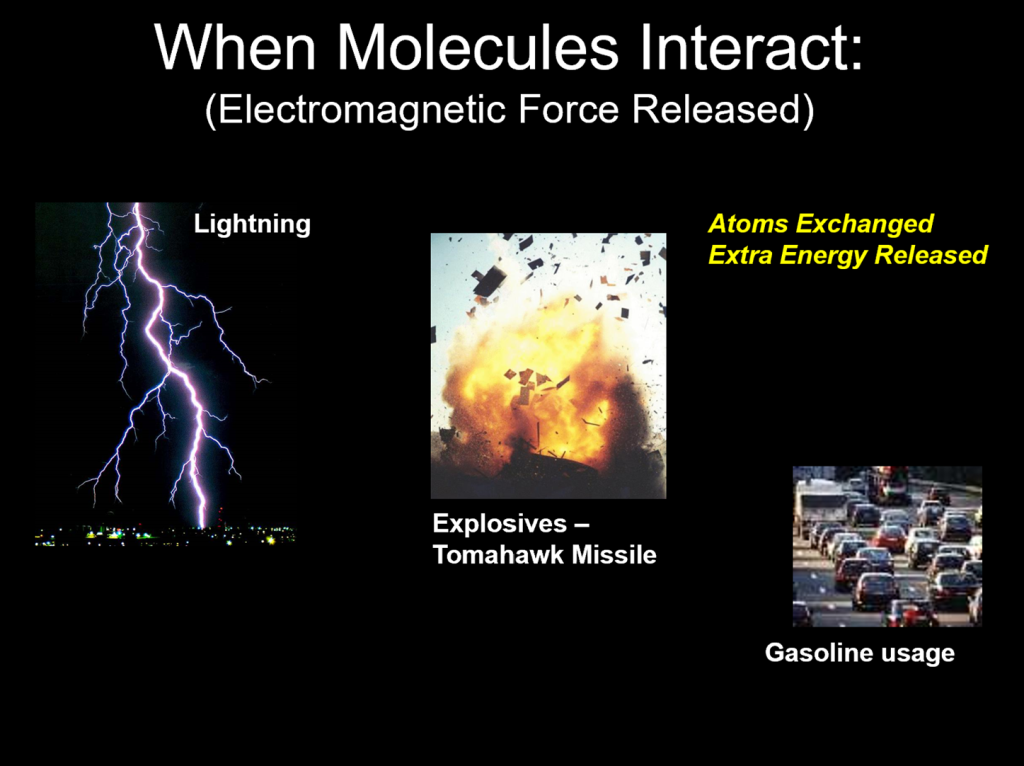
We have learned in Part 1 that atoms and molecules can both contain extra energy which often drives a reaction. The energy is then released to the environment. This energy is sourced by the electromagnetic force that holds the electrons to the nucleus. It is most important to understand that the atoms are NOT “burned up” or destroyed, just simply re-arranged into a more stable molecule with less energy. This extra energy is only a tiny fraction of the total energy in a molecule or atom, and yet, this excess energy can have huge consequences.
Figure 5 shows a few examples of what can happen when molecules with extra energy react to form other molecules. The explosives in a Tomahawk missile are simply the release of the extra EMF energy. Our vast number of automobiles are powered by the release of extra energy in gasoline as it also reacts to form carbon dioxide and water. Atoms are over 99% space, and yet the “hardness” of a steel ball is simply the EMF that is holding the iron molecules together.
Part 2 will address another force in the atom that is hundreds of times stronger than the EMF. This force will require the use of our butter bean. And it’s this force that we’ll relate back to Scripture to more fully appreciate the omnipotence of our God.
And remember that mysterious word “stoichiometry.” In Part 2 we’ll reveal just why this term is so critical for understanding several verses of Scripture.
Figure 1. Combined view of the Crab Nebula from Hubble and Herschel telescopes (left). The supernova occurred in 1064 A.D. and was visible from Earth in daylight; NASA Jet Propulsion Laboratory. The figure to the right is a close-up of the center core of the nebula showing the neutron star at its core, and “pulses/waves” in the intense magnetic field.
Left: https://www.jpl.nasa.gov/spaceimages/details.php?id=PIA17563
Right: Credits – NASA and ESA, Acknowledgment: J. Hester (ASU) and M. Weisskopf (NASA/MSFC) https://www.nasa.gov/feature/goddard/2016/nasas-hubble-captures-the-beating-heart-of-the-crab-nebula
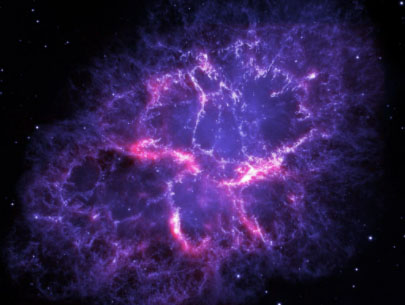
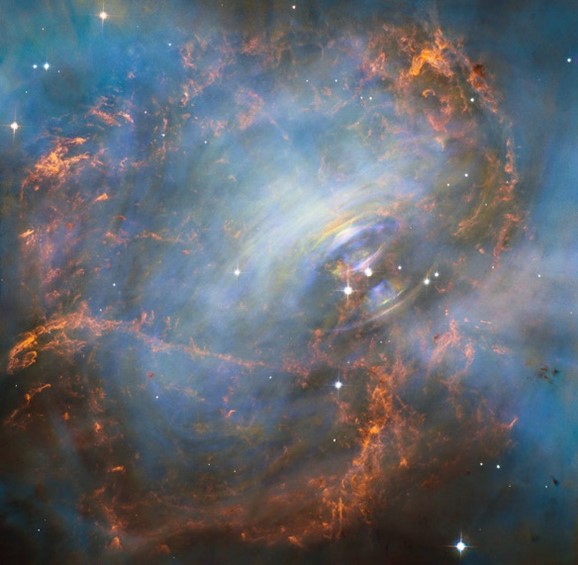
Figure 2. The “horseshoe” magnet. Opposites attract each other and likes repel. This attraction is the same force that holds the electrons in orbit around an atom’s nucleus.
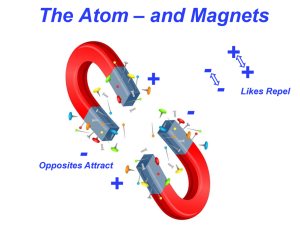
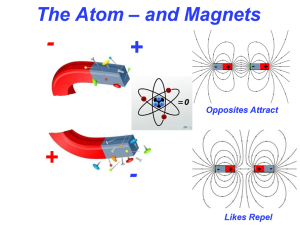
Figure 3. Gallium arsenide (light blue) with cesium atoms sputtered on the surface.
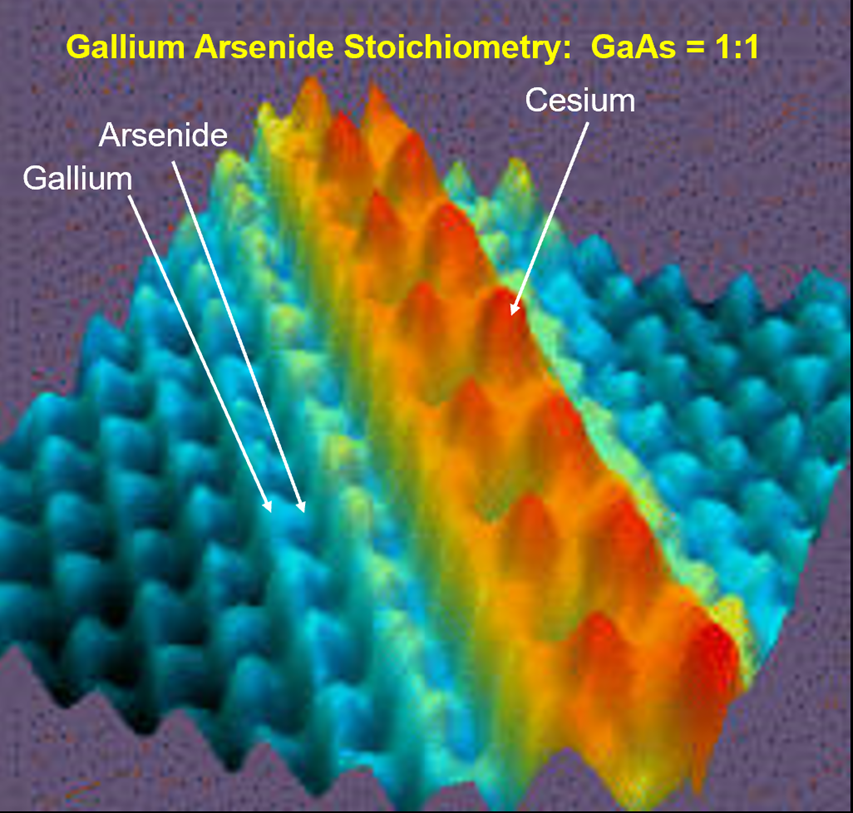
Figure 4a. Methane is produced from deeply buried gas fields. When it arrives at the surface it has extra energy and becomes highly reactive.
Figure 4b. When a flame is lit on a stove-top, the methane molecules react with oxygen, release the extra energy as the flame, and re-arrange into carbon dioxide and water.

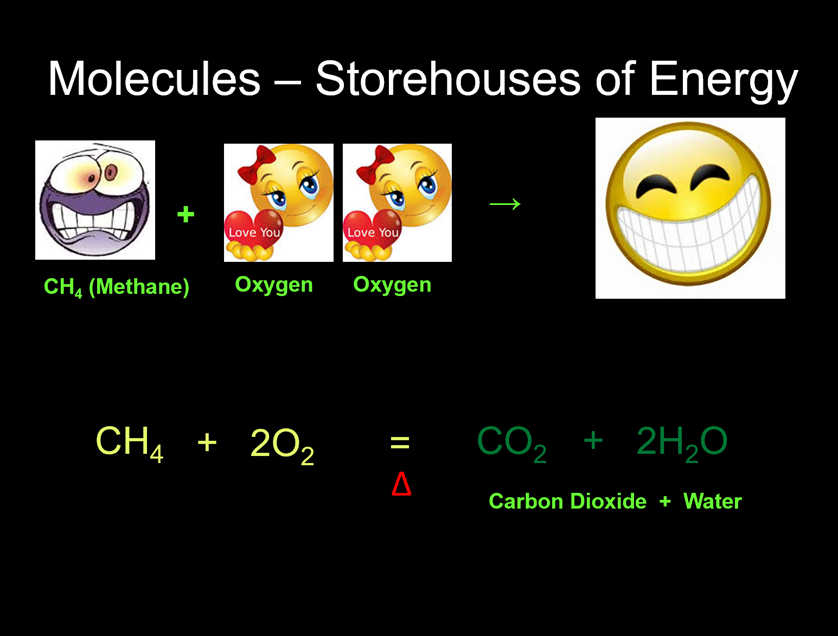
Figure 5. Examples of the tremendous EMF energy that is released simply when molecules interact. This is only a tiny fraction of the total energy within an atom.