Thank you for persevering through the “Time” discussions!
The last three papers were likely controversial and perhaps disturbing for those readers who hold a “Young Earth” view. Given the astonishing contrast between the Young Earth’s proposed age of creation (15 thousand years) versus its age as interpreted through earth science and astronomy (15 billion years), each view may seem bewildering to the other party. And if you hold the Young Earth view it may be tempting to ignore the science, but Scripture says otherwise.
We could devote the next ten papers to debate these contrasting views; however, I’d like to take a fresh approach.
Our two theme verses (Psalm 19:1-2; Romans 1:18-23) clearly state that Creation reflects the attributes of God:
- Psalm 19:1-2 – “… the heavens reflect the glory of God, and the expanse declares the work of His hands…”
- Romans 1:18-23 – “… For since the creation of the world His invisible attributes, His eternal power and divine nature, have been clearly seen, being understood through what has been made…” (Rom. 1:20)
But how?
How is God’s glory really reflected in the heavens? How does the “expanse” (empty space) actually testify to the work of His hands? And finally, how are His invisible attributes (“His eternal power and divine nature”) clearly seen in this world He created?
These claims are not hypothetical statements. If we “look” and attempt to “understand,” we should see the attributes of God. And since scientists, and especially astronomers, spend their careers peering into the heavens, they should provide a test case for these verses.
Do scientists discover God by studying His creation? They view the heavens and the earth through a perspective of great age. Do they still discover God?
This will be our “new approach.” Let’s see what the scientists see and discover if/how God impacts them through His creation. And remember, scientists coined the term “Intelligent Design.”
* * *
Good dental hygiene was not a priority during my early years through high school and into college. I only visited the dentist three or four times and was fortunate to have only one cavity. After college, I began to schedule regular visits. My first dentist performed a series of thorough exams, including a pano x-ray. That was my first experience with precautionary x-ray shielding—he placed a lead apron over my torso that must have weighed 25 pounds. I gained a new respect for x-ray radiation during those visits, although I knew very little about its true energy or actual threat. And I certainly didn’t appreciate the concern over x-rays in outer space nor the safeguards that God provided us when crafting our planet. That’s our next topic—let’s see what the scientists see.
* * *
M-87: The Hostile Galaxy
In the last document I introduced the Virgo supercluster of galaxies and used M-100 to demonstrate consistency between astronomical distance measurement methods. But this important cluster of galaxies deserves further attention.
As in the last lesson, if you look toward the eastern summer sky with a good pair of binoculars and find the Virgo constellation, you may notice within Virgo’s “arms” the small, fuzzy “stars” amidst the brighter, sharper stars of our own galaxy. The faint and fuzzy “stars” are actually galaxies within the supercluster (over 2000) that are closest to earth.1, 2 Figure 1 shows the location of several galaxies within the Virgo constellation, and specifically, the location of M-87. Figure 2 shows an expanded image of the area that includes M-87 and several other galaxies.
My reason for focusing upon this supercluster is centered on galaxy M-87. This elliptical galaxy contains over a trillion stars and is one of the largest and most massive in the local universe. The total mass may exceed that of our galaxy by more than 200 times. It is also a prominent subject of research.
One simple image of M-87 from the Hubble Space Telescope (Figure 3) instantly captures one’s full attention. A “jet” of sub-atomic particles is blasting out of the galaxy’s center powered by the largest black hole in our sector of the universe. The jet is approximately five thousand light years in length. Figure 4 shows expanded versions of the jet from radio wave (VLT) and x-ray (Chandra) radiation imagery, as well as visible light waves from the Hubble Space telescope (HST).
Spiral vs. Elliptical Galaxies
There are two basic types of galaxies. Spirals are basically flat with a prominent spiral structure as shown by M-100 (see previous blog). Elliptical galaxies are large and globular with little, if any, internal structure. Star density generally increases towards the center.
Figure 5 shows a spectacular, recent (2017) image from the “Event Horizon” telescope—a global network of radio wave telescopes linked together, acting as one. The image shows the shadow of the black hole in the center of the galaxy surrounded by an emission ring of radiation.
The supermassive black hole is another incomprehensible aspect of God’s creation—its mass is billions of times that of the Earth’s sun. The radius of the emission ring is .0110 light years, or about 18 times larger than our solar system (the diameter of Pluto’s orbit around the sun; Figure 6).
“Radio” Telescopes
Telescopes magnify radiation energy. The traditional telescopes we think of use radiant energy from the visible light frequencies. However, other telescopes use x-ray and radio frequency radiation. These radiation sources are more energetic and produce higher resolution imagery.
The shadow is about eight times the size of our solar system. The distance at which light energy and matter cannot escape the gravity of the black hole is calculated and termed the “Schwartzschild Radius.” It is three times the size of our solar system. And finally, the black hole itself (non-visible) is estimated to be about the size of our solar system; it consumes about 90 Earth masses per day.1
This monstrous black hole is the largest and closest to Earth of any in our region of the universe. Mass falls into the black hole and is crushed by gravity producing a blast of x-ray, gamma-ray, and radio-wave radiation. A portion of this energy escapes through the visible jet and a second jet on the opposite side of the black hole.
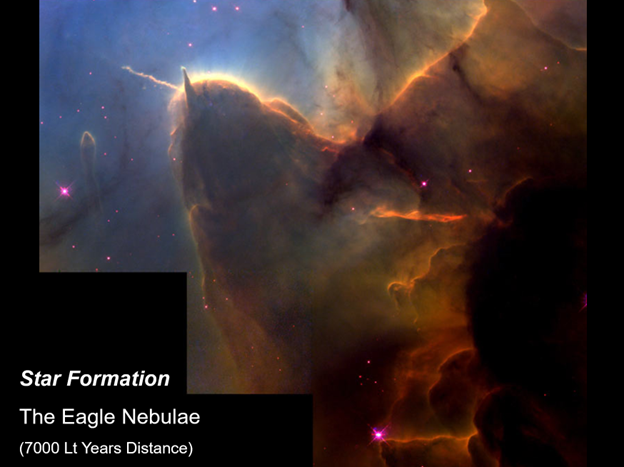
Just how intense is the x-ray radiation from M-87? Here’s an example. Most galaxies are “dusty.” They contain silicate and other mineral grains formed deep within the stars. The dust grains are released (blown away and scattered throughout space) when the dying star explodes in a supernova event. Dust is clearly visible in our own Milky Way galaxy and forms colossal “clouds” like the Eagle Nebulae (Figure 7). The quantity of dust within our galaxy has been estimated to be 100 million (108) solar masses (a “solar mass” is the mass of our sun). In contrast, the combined mass of dust in M-87 is no more than 70 million solar masses, even though its total mass may be over 200 times greater than the Milky Way. Why is there less dust in M-87? The immense x-ray radiation is so intense that most of the dust within M-87 has been destroyed – the silicate grains have dissolved (as would the amethyst in your ring).
Consider this—over a trillion stars in M-87, and no chance for life as we perceive it. But it doesn’t end there. A cloud of x-ray emitting radiation has engulfed many of the galaxies within the Virgo supercluster nearby M-87. Think about that. Millions to billions of stars in a typical galaxy and they, and their planets, are being irradiated by powerful x-rays and other dangerous radiation.4
But how much? How close does the threat extend toward Earth? Are we at risk?
M-87: An Intergalactic Radiation Source
In addition to the massive x-ray emissions, galaxy M-87 is one of the most powerful radio galaxies known and the strongest among the thousands of galaxies in the Virgo supercluster.5 It shines like a beacon in the skies in the radio frequency range. It is also one of about 25 galaxies known to produce very high energy gamma rays that strike the Earth. However, until 2009 the source of the gamma radiation within those galaxies was not discernable.
In 2009, a collaborative viewing by a panel of scientists with several large, Earth-based telescopes was underway. Fortuitously, a powerful burst of radio and gamma radiation from M-87 was detected during their observations. X-ray radiation also struck our orbiting satellites. The team focused their studies on M-87 and determined that the high-energy gamma rays were emitted very near its black hole.6 Their work confirmed that the black hole in M-87 is at least one source of the gamma and cosmic radiation that reaches Earth.
Cosmic and Gamma Radiation
Cosmic radiation is produced when elementary particles (the bare nucleus of an atom, stripped of its electrons) are accelerated by a black hole to extremely high energies—millions of times more powerful than achieved by the largest particle accelerator on Earth (the LHC at CERN).7 The particles travel at nearly the speed of light and pose great risk to astronauts in space.
Gamma radiation is a trillion times more energetic than visible light. This extremely high energy radiation is produced as the elementary particles are accelerated by the black hole.
So, let’s summarize a couple of points from above. First, we learned a sobering aspect about our universe—it is a hostile and deadly place for human beings. We examined galaxy M-87 with over a trillion stars, 55 million light years from Earth, and one of the largest in our sector of the universe. Its super-massive black hole spews out immense x-ray and radio radiation with such intensity that life within the galaxy is infeasible. And the radiation engulfs several other galaxies within the Virgo supercluster, as well.
Second, scientists over the past decade have discovered that the powerful black hole in M-87 generates very high energy gamma and cosmic radiation. Hence, M-87 is the source of at least some portion of the gamma and cosmic radiation (and x-rays, as well) that bombards the Earth and threatens the astronauts.
You may be wondering, just how dangerous is the radiation, how harmful are its effects on the astronauts, and even more importantly, how much do we receive here on Earth? We’ll explore these topics below.
Radiation Toxicity and Exposure Limits
The information in this section may not be for you. It is included for those curious individuals who seek to understand why radiation is dangerous, and at what exposure limits. For those less inclined, I’ll share in this paragraph what you need to know for the final section (below): 1) Health authorities recommend a continuous, annual radiation exposure limit of less than one millisievert above background, and less than five millisieverts annually as an infrequent dose; and, 2) radiation workers have an elevated, annual exposure limit of 50 millisieverts. So, just remember one-, five-, and 50-millisieverts as annual limits, and feel free to skip to the next/final section, ‘Radiation Dosages in Space.’
* * *
If you follow our country’s space program and watched the early, televised, manned-rocket launches, or perhaps viewed the Apollo 13 movie, you understand that outer space is dangerous. The near-perfect vacuum (decompression plus no oxygen), the searing temperatures in direct sunlight, and frigid temperatures in a shadow make survival impossible outside of the module, or otherwise, outside of a spacesuit. However, radiation is another risk that often goes unmentioned.
There are two basic types of radiation: Ionizing and non-ionizing. The infrared and ultraviolet wavelengths are examples of non-ionizing radiation. They can cause damage (like sunburns) to living organisms but are easily shielded. X-rays, gamma radiation and galactic cosmic radiation (GCR) have phenomenally higher energy levels and can cause very serious or even fatal health effects. GCR, in particular, behaves like an atomic-level bullet. The ultra-high-energy particles can pass through a spacecraft and/or a human body. They have enough energy in a collision with an atom to completely displace the atom’s electron(s), leaving a positively charged ion. The particle can then create a shower of other, secondary displacements. The effect is an atomic-level track of damaged tissue and the possibility of DNA mutations.8, 9
The measure used for radiation exposure is termed “millisievert.” A thousand millisieverts make one “Sievert.’’ A single millisievert is equivalent to about three chest x-rays (i.e. a chest x-ray provides about 0.3 millisieverts of radiation).9 We receive about 2.5 millisieverts of natural background radiation annually on Earth’s surface.
Several factors such as age, gender, pregnancy, etc. affect what the “safe” exposure limit should be for an individual. In 2000, the National Council of Radiation Protection (NCRP) issued its recommended, annual radiation exposure limits for public individuals and for workers exposed to elevated radiation levels (NCRP Report 116, summarized in Table 1). The NCRP recommends an annual limit of 1.0 millisieverts of radiation (above local background) for the general public and 5.0 millisieverts per year for an infrequent exposure.10 Radiation workers are generally carefully monitored, educated on radiation poisoning, and are frequently shielded. Hence, they have much larger exposure limits (50 millisieverts per year). We’ll use these limits below to evaluate the risk from radiation in outer space.
Radiation Dosages in Space
Five pages of text were required to reach this point. We are finally ready to answer our initial question: “Just how dangerous is the radiation in outer space, and why does it point us to God?”
Over the past two decades there have been multiple studies and even specific satellite launches to determine the levels of radiation exposure from sources like M-87 in interplanetary space.8,9 The results are frightening. Keep in mind that the annual recommended exposure limits are one- and five-millisieverts above background for the public, and 50 millisieverts for radiation workers.
It is believed that the annual radiation exposure for astronauts traveling in intergalactic space, or for colonists on Mars, would be 400-900 millisieverts per year. That’s equivalent to 1200-2700 chest x-rays per year, or one x-ray every 7.3 to 3.2 hours, respectively, for a full year.
You can see why NASA is diligently studying space radiation.
However, these radiation levels are trivial when compared to another source we have not mentioned—our sun! Earth literally sits in the backyard of a massive fusion bomb. The sun’s incredibly high temperatures ionize atoms and liberate protons. During a major solar flare event, the protons are so greatly energized that they explode from the sun’s magnetic field. If the flare is directed toward or near the Earth, our planet and any orbiting astronauts are blasted with these high energy particles (termed a “solar particle event”, or SPE). The radiation dosages during such an event can approach or exceed 5,000 millisieverts (500 Rads).11, 12 One of the largest SPE’s occurred between (fortunately) the Apollo 16 and 17 missions to the moon. Here are NASA’s comments:
Between the Apollo 16 and 17 missions, one of the largest solar proton events ever recorded occurred, and it produced radiation levels of sufficient energy for the astronauts outside of the Earth’s magnetosphere to absorb lethal doses within 10 hours after the start of the event. 13
And that’s the theme of Part 1. Earth is bombarded by dangerous to lethal levels of radiation on a continuous basis—and yet, here we sit, talking about it . . .
How?? Why are we able to survive??
Because we live on an exquisitely crafted planet designed to support human life. Earth is a product of so many miracles that scientists with an open mind proclaim that design was required by God; and hence their phrase, “Intelligent Design.” And that’s the theme of Part 2.
1Wikipedia; Messier 87; https://en.wikipedia.org/wiki/Milky Way
2NASA; Hubble’s Messier Catalog: Messier 87 (October 19, 2017); https://www.nasa.gov/feature/goddard/2017/messier-87
3Wikipedia: Milky Way Galaxy; https://en.wikipedia.org/wiki/Andromeda_Galaxy
4 NASA Why Space Radiation Matters; https://www.nasa.gov/analogs/nsrl/why-space-radiation-matters
5Britannica: M-87 Galaxy
https://www.britannica.com/place/Virgo-A
6Acciari VA et al. (The VERITAS, H.E.S.S., MAGIC Collaborations and the VLBA 43 GHz M87 monitoring team). Radio Imaging of the Very-High-Energy Gamma-Ray emission region in the Central Engine of a Radio Galaxy. Science, 24 July 2009; 325 (5939), 444-448 DOI: 10.1126/science.1175406
7ETH Zurich. “Astrophysics: High Energy Galactic Particle Accelerator Located.” ScienceDaily. ScienceDaily, 14 September 2009. www.sciencedaily.com/releases/2009/09/090911210539.htm
8Wikipedia: Health Threat From Cosmic Rays
https://en.wikipedia.org/wiki/Health_threat_from_cosmic_rays
9NASA Why Space Radiation Matters; https://www.nasa.gov/analogs/nsrl/why-space-radiation-matters
10Oncology Medical Physics.com: NCRP-116 (2000)
Radiation Limits: NCRP-116 | Oncology Medical Physics
11Wikipedia; Solar Particle Event: Solar particle event – Wikipedia
12Stereo: Studying the Sun in 3-D; Sickening Solar Storms: https://www.nasa.gov/mission_pages/stereo/news/stereo_astronauts.html
13NASA: What is Space Radiation? What (nasa.gov)
Table 1: Summary of Exposure Limits from NCRP Report 116.

Figure 1. Virgo constellation, showing location of several galaxies within a tiny portion of the Virgo supercluster. Notice location of M-87.

Figure 2. Higher resolution image of several prominent galaxies within the Virgo Supercluster. Notice location of the giant, elliptical M-87 galaxy.

Figure 3. Galaxy M-87 and its famous ‘black-hole-powered’ jet of sub-atomic particles traveling at nearly the speed of light. The black hole is positioned in the center of the galaxy. The glow of the galaxy is sourced by over a trillion unresolved stars.

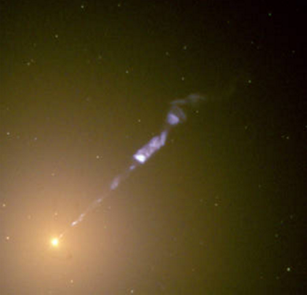
Figure 4. Images of M-87’s jet using telescopes with various wavelengths of radiation energy.
“Core” or source of jet in center of M-87
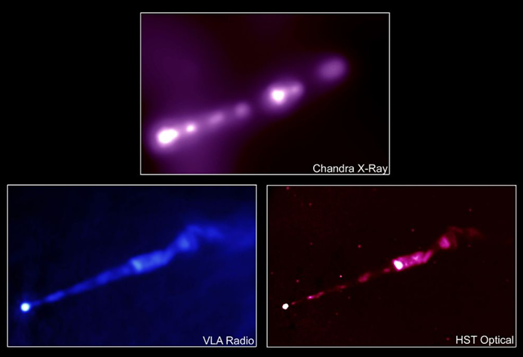
Figure 5. Event Horizon telescope image of M-87’s core showing the large shadow from the black hole – the first ever imaged.

Figure 6. Size comparisons to the M-87 black hole and our solar system.

Figure 7. The Eagle Nebula in our Milky Way galaxy. This is an example of the massive amounts of dust that reside within our galaxy.