This has undoubtedly been a challenging blog to read, and likely the most technical blog I will author. However, God’s Omnipotence is amazing once you sense the mighty forces associated with the atom. I hope and pray that every reader will share the awe that I experienced after exposure to these details.
In Part 1 we discussed the atom and its structure. We also examined the first of two forces—the electromagnetic force (EMF)—that God constructed within the atom. This force attracts the electrons to the nucleus and paves the way for our discussion of the second force in Part 2. This force is hundreds of times stronger than the EMF and its origin resides in the nucleus of the atom. We’ll briefly examine this second force in Part 2; and, along with our butter bean and Scriptures, hopefully reveal the Omnipotence of God. Please hang in there!
* * *
One of my games as a kid with the magnet set (see Part 1) was to see how many negative or positive magnet ends (same charge only) that I could stack together and hold in place. Upon release, the magnets would fly apart, driven by EMF repulsion. Although unaware at the time, this has relevance to the nucleus of the atom, as well.
Technical Foundation
Now, imagine a uranium atom with 92 positive charges (protons) packed tightly together in the nucleus along with 146 neutrons (92 + 146 = 238, the atomic weight of uranium; hence, 238U). How in the world can these 92 positive charges remain closely packed and not blow itself apart? That’s the job of the Strong Nuclear Force (SNF).
This is a complicated force and we’ll spend very little time with its origin. As a high-level summary1, it results from the rapid exchange between protons and neutrons of a tiny subatomic particle called a “meson.” Think of a ping-pong ball bouncing back and forth. The exchange of the mesons and the slight separation of the protons by the neutrons create the SNF which is strong enough to hold those 92 protons together.
How does this relate to God’s omnipotence? Again, it comes back to excess energy.
Natural uranium is slightly unstable (radioactive) and is about 99.3% 238U. However, other uranium atoms may contain fewer neutrons (termed “isotopes”) and this gives the nucleus and its atom excess (nuclear) energy. Perhaps you have heard of 235U. It’s missing three of its neutrons and is highly reactive (radioactive – extreme excess energy). This is the isotope extracted by the government to produce atomic bombs and nuclear reactor fuel.
When 235U is concentrated, formed into ceramic pellets of about 3-5% 235U, and then stacked together in a reactor core, it becomes a dangerous source of extreme energy.2 The isotope is so unstable that when a single, stray neutron strikes a 235U atom, the nucleus breaks apart (fissions; Figure 1) to produce two new atoms—barium and krypton. It also releases three additional neutrons which strike and fission other nearby 235U atoms, initiating a chain reaction. This reaction is controlled (slowed or quenched) in a reactor by inserting carbon rods into the reactor core (the 235U stacked bricks) to absorb most of the additional neutrons. (When the reactions in the core are not slowed down, a nuclear meltdown results, similar to Chernobyl.)
If 235U or plutonium (another radioactive metal very similar to 235U) is packed into a baseball-sized metal ball weighing about 13 pounds and detonated without any control rods, an atomic explosion occurs. That’s the weight of plutonium in the bomb that was dropped on the edge of Nagasaki, Japan to end World War II. Only about 20% (2.5 pounds) of the plutonium fissioned. The explosion was equivalent to 21,000 tons of TNT. It injured approximately 75,000 people and killed about 74,000.
The Butter Bean
As you might imagine, each time a U-atom fissions, it releases an amazing amount of excess energy as heat. Hence, the reactor core becomes an incredible source of extreme heat. And here’s where the butter bean becomes important.
Pick up that bean and feel its weight. The mass of an average butter bean is around one gram. How does that compare to the equivalent mass of 235U consumed each day in the reactor core, and how much energy, or power, does that equate to? Figure 2 provides a pictorial summary.
A nuclear reactor generates about 1000 megawatts of power per day and uses about 3 Kg (3000 grams) of 235U.4 One gram of 235U (your butter bean mass), when fissioned in a reactor core each day, generates roughly the same amount of power as 30 pounds of coal, or about 45 Kwh of electricity.5 That’s the power consumption by an average U.S. family household over a day and a half.6 And again, it’s sourced only from excess energy. The 235U atoms are simply split into two smaller and more stable atoms as the excess energy is released. But it’s only a tiny, tiny fraction of what really exists within that bean.
The Butter Bean—And Einstein
We are now at the point where I can discuss the phenomenal energy that resides within your butter bean. So far, we’ve only examined the excess EMF and SNF energy within an atom. The energy from these two sources alone may seem overwhelming. However, the total energy of the bean is defined by Albert Einstein’s famous equation:
E = mC2
This equation states that mass and energy are interchangeable. In other words, mass itself can be converted into energy. If the excess energy is as powerful as we’ve discussed, can you imagine how much total energy would be released from just one gram of matter—that is, from your butter bean? Another pictorial summary is provided in Figure 3.
Your single, one-gram butter bean, if converted to pure energy, would produce about 25,000 megawatt-hours of power. That’s about 20 times beyond the daily power output of a nuclear reactor. It’s equivalent to the annual U.S. energy consumption of a city of roughly 10,000 people, or 2350 households. But another more sobering comparison must be made. If instantly dispersed, it’s the same amount of energy released by the atomic bomb dropped on Nagasaki—from one butter bean.
And now, back to Scripture.
The Butter Bean—And the Future
So finally, let’s tie all of this together. I shared about the potential power in a one-gram butter bean. Now, imagine the mass of our earth, the moon, all the planets of our solar system, the sun, our galaxy, and every galaxy in the universe. That’s mass beyond comprehension, correct? And all of that mass, if converted to energy would be equally unfathomable, correct?
Let’s examine a few verses from Scripture:
Col 1:16, 17
“…all things have been created by/through Him (Jesus) and for Him. And
He is before all things, and in Him all things hold together.”
Heb. 1:3
“And He (Christ) is the radiance of His (God’s) glory and the exact representation of His nature, and upholds all things by the word of His power…”
Is this just figurative language? Does Christ truly hold “all things together?” Let’s look a little further at two more verses:
Matt. 24:35
“Heaven and earth will pass away, but My words will not pass away”
Rev. 21:1
“Then I saw a new heaven and a new earth; for the first heaven and the first earth passed away.”
The Greek word for “pass away” is “parerchomai” which means to “pass by” as in “come and gone;” or, to “perish.” So, if Jesus holds “all things together,” and if the “first heaven and first earth (will; JRC) pass away,” or perish, then what happens? Scripture gives us another startling clue:
2 Peter 3:10-12
“But the day of the Lord will come like a thief, in which the heavens will pass away with a roar and the elements will be destroyed with intense heat, and the earth and its works will be burned up… What sort of people ought you to be… looking for the day of God, on account of which the heavens will be destroyed by burning and the elements will melt with intense heat.”
Peter is describing a universal (heavens and earth) cataclysmic event. But exactly what does he mean by the destruction and melting of the “elements”?
The Butter Bean—And God’s Omnipotence
Well, here’s where we’ve been heading in this blog since the first sentence of Part 1. Remember our mysterious word in Part 1 – “stoichiometry,” which is the smallest ratio of atoms that form a molecule (we used the example of water, H2O, with a 2:1 H:O stoichiometry)? Here’s what the word “element” is, and means, in the original Greek language:
Element (Gk. Stoicheion):
Strongs Concordance – something orderly in arrangement, i.e. a serial constituent
Zodhiate’s Lexicon – the elements or first principles of matter (atoms – JRC) from which other things (molecules – JRC) proceed
in order, or of which they are composed.
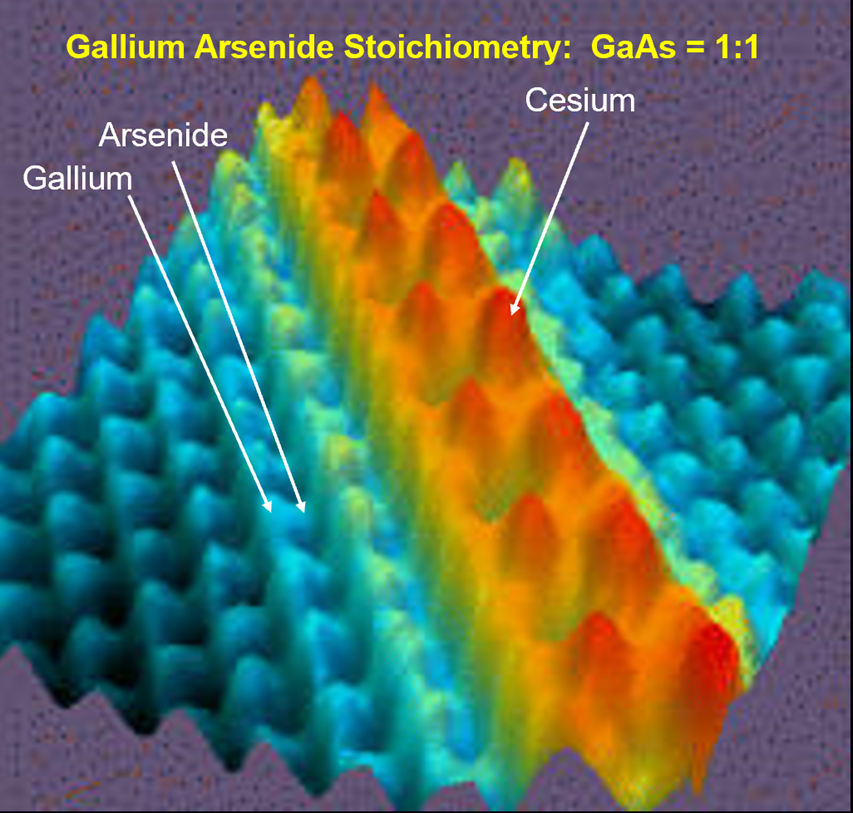
“Stoicheion” is the Greek word from which “stoichiometry” is derived. I’ve included the figure from Part 1 that shows the greatly magnified surface (the atoms and molecules) of gallium arsenide in a semiconductor (Figure 4). The orderly and linear series of molecules are a beautiful, physical example of what Peter, that early 1st Century Galilean fisherman (a.k.a. nuclear physicist) apparently described via revelation by the Holy Spirit. The “first principles of matter” appear to be atoms and the “other things which proceed in order” could certainly reflect molecules.
In conclusion, the “Day of the Lord” is likely the point in time that Christ returns to judge the world. The scriptures suggest at that point, Jesus will no longer “hold all things together” in our present universe. It sounds as though he will simply release all the mass—every atom and molecule throughout the universe. Everything reverts to energy – a universal nuclear explosion where every particle simply “melts away with intense heat”. How else could Peter explain it in 1st Century terminology?
And now I hope you better appreciate the true omnipotence of our Lord and God—the One who holds every atom in the universe together… and the same One they hung upon a Roman cross…
1The Strong Nuclear Force: https://aether.lbl.gov/elements/stellar/strong/strong.html
2U.S. Energy Information
Administration; Nuclear Explained: The Nuclear Fuel Cycle; https://www.eia.gov/energyexplained/nuclear/the-nuclear-fuel-cycle.php
3Wikipedia: Fat Man (the Nakasaki Atomic Bomb; JRC): https://en.wikipedia.org/wiki/Fat_Man
4Nuclear Power-Fuel Consumption of Conventional Reactor: https://www.nuclear-power.com/nuclear-power-plant/nuclear-fuel/fuel-consumption-of-conventional-reactor/).
5European Nuclear Society Fuel Comparison: https://www.euronuclear.org/glossary/fuel-comparison/
6U.S. Energy Information Administration; Frequently Asked Questions: https://www.eia.gov/tools/faqs/faq.php.
7OMNI Relativity Calculator: https://www.omnicalculator.com/physics/emc2
Figure 1. The atomic fission of uranium (235U). Notice that one atom each, of krypton and barium, are produced, and three neutrons are released when the uranium nucleus splits. The three neutrons can then strike three other 235U atoms, initiating a chain reaction.
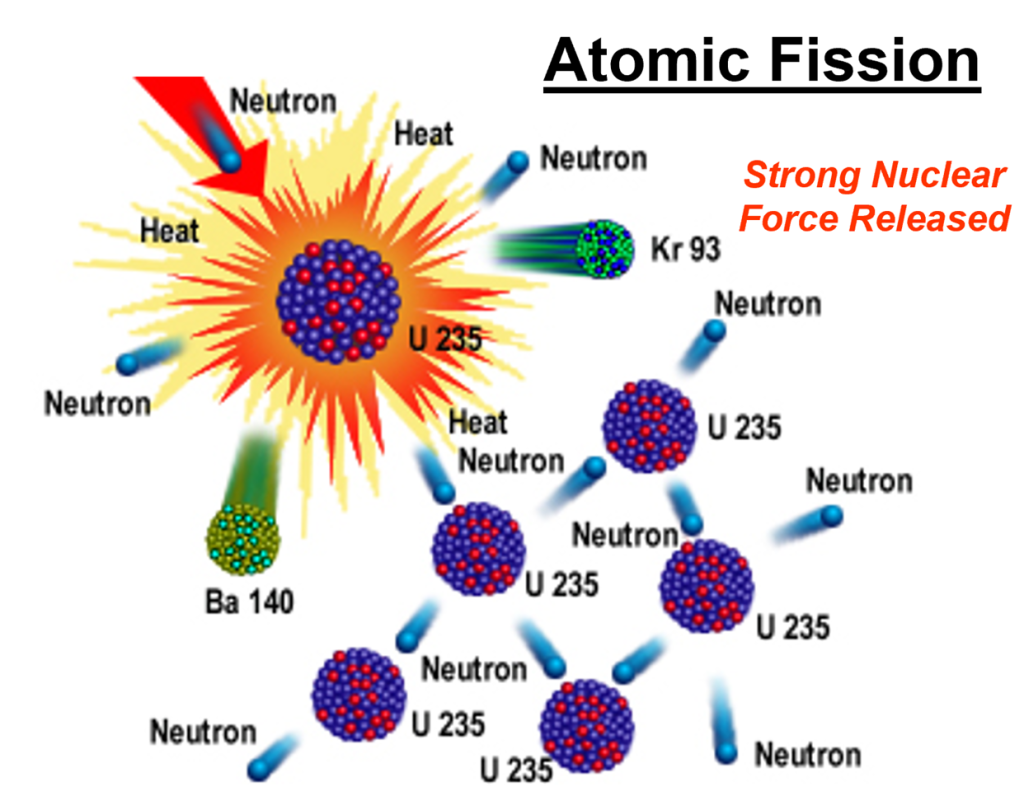 Figure 2. Comparisons of power from the Strong Nuclear Force energy produced by the fission of one gram of 235U (one butter bean’s mass) with the equivalent energy from other sources.
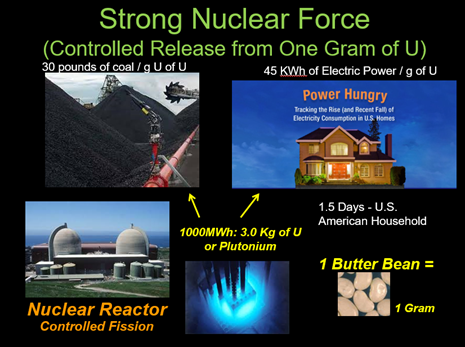
Figure 3. Comparisons of the energy produced by the conversion of one gram of mass (a butter bean) with other energy/power sources.
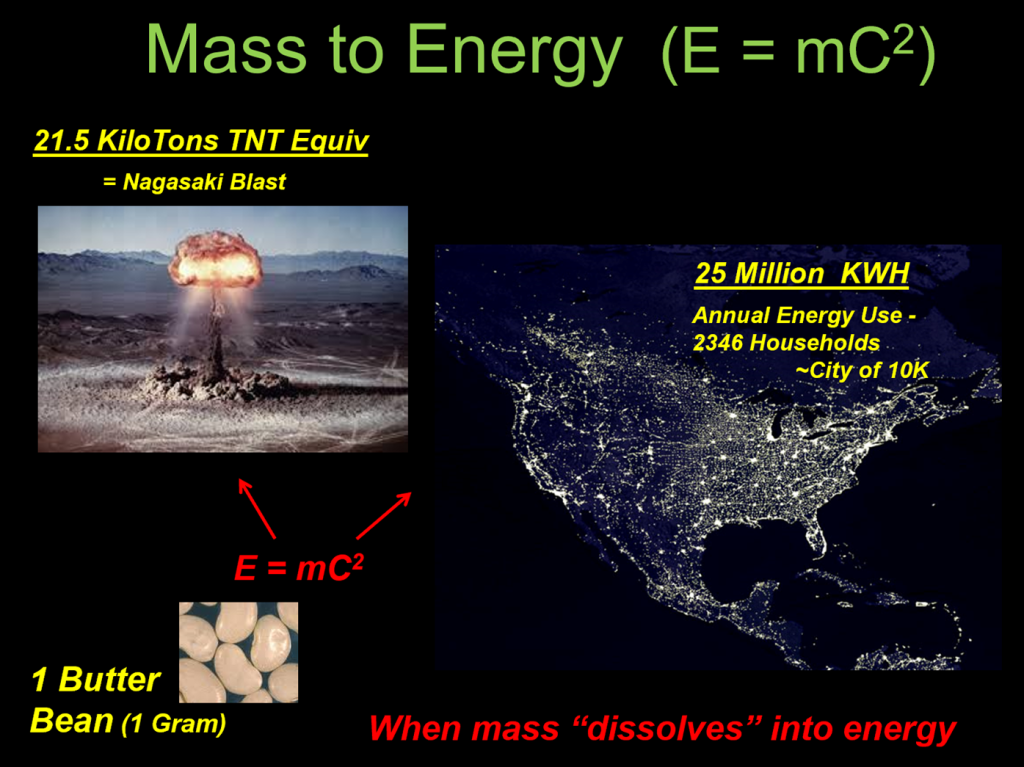
Figure 4. Gallium arsenide molecules (light blue) with cesium atoms sputtered on the surface.