
Why would an increase in your velocity (your location’s frame of reference) to 99% of the speed of light slow down your passage of time by 400-fold? That’s the rocket ship scenario we discussed previously (Blog #38, introduced in Blog #17). This blog addresses that question. If successful, it will de-mystify the “slowing” (dilation) of time.
Full credit for my explanation of time dilation, its application to Scripture, and the development of the Time Dilation model go to Dr. Gerald L. Schroeder and his book, The Science of God.1 Schroeder is an Orthodox Jew with command of the ancient Hebrew language. He received his PhD in Nuclear Physics and Earth and Planetary Sciences in 1965 from the Massachusetts Institute of Technology (MIT). He worked seven years on the MIT staff and was a member of the United States Atomic Energy Commission.2 Today, Schroeder teaches at the College of Jewish Studies Aish HaTorah’s Discovery Seminar, Essentials and Fellowships programs, and Executive Learning Center.
The technical content included herein may exceed the preference of some readers, but please persist! If you will, the beauty of time dilation’s integration of the Old and Young Earth Models will be even further magnified!
* * *
Light, Wavelength, and Frequency
Light is a form of energy—it travels across space in a series of waves like the ripples on a pond after a stone breaks the surface (Figure 1). The distance between the crests of the waves in either a pond or a light ray is termed its “wavelength” (one wavelength = one cycle)
The energy radiation spectrum includes a huge range of wavelengths, from approximately 10 centimeters (cm; about four inches) for microwave radiation (just like your oven) to less than one billionth of a centimeter for gamma ray radiation (Figure 2). When we speak of “light” we generally refer to that portion of the spectrum visible to our human eyesight. We see the red (0.0001 cm) to blue range (0.00001 cm) of wavelengths.
Schroeder refers to light as, “the clock of the universe.”3 We see the association of “time” with light when we consider its “frequency.”

Given the tiny wavelengths of visible light and light’s tremendous velocity (186,000 miles/second) the frequency of visible light is a huge number indeed (about 500 trillion cycles/second). The number of wavelengths that pass a given point in one second can vary by orders of magnitude depending upon the type of radiation (see Figure 2), but every photon of light within that series of wavelengths travels constantly at the speed of light.
One other point deserves mention. A specific “second’s-worth” of light cycles is also a measure of distance, and “distance per second” is also a measure of velocity, or the speed of light (C; 186,000 miles per second in a vacuum). This leads to the following equation and sets up the following section.

Time Dilation—How it Works
Let’s return to our rocket-ship example and simplify it by using a smaller, fictitious value for the frequency (or speed) of light—one that we can grasp. In this example, we’ll say that the frequency of light on Earth is 5500 cycles per second (rather than 500 trillion). This leads to the following equation:
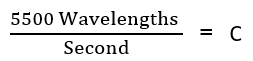
And, if our rocket ship can indeed travel at 99% of the speed of light, that means that for each second on our rocket ship, only 55 cycles of light pass us by.
[5500 – (5500 x 0.99)] = wavelengths [5500 – 5445] = wavelengths55 = wavelengths
So, we are traveling almost as fast as the light cycles themselves. From our perspective on the rocket ship, the cycles of light have been “stretched out” so that only 55 wavelengths pass us by. However, we must maintain our relationship with C, the actual speed of light. To do so, our passage of time (seconds) on the rocket ship must also decrease to preserve C:
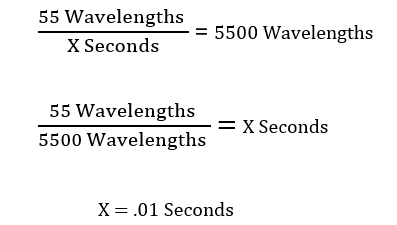
In this simple, fictitious example, only 0.01 seconds of time on our rocket ship would pass for every one second of time upon Earth. Time on our rocket ship would be passing 100 times slower than on Earth, and the wavelengths of light would have been stretched out 100 times to a frequency of 55 wavelengths per second.
And yet, even though we see the simple algebraic relationship between velocity and the passage of time, it still bends our minds when we try to comprehend it!
Time Dilation—The Third Mechanism
We have finally reached the point where Dr. Schroeder’s Time Dilation model can be introduced and discussed. It is, for me, by far the most compelling creation model—it is elegant, persuasive, and integrates the most relevant arguments from each of the Old Earth and Young Earth models.
We’ve acknowledged that both velocity and gravity slow the passage of time. And I’ve mentioned that a third mechanism exists, one that was also responsible for the red-shift observations described by Edwin Hubble (Blog #17). We noted that the red-shift effect was produced by the expansion of space itself, and not the recessional velocity of the galaxies from Earth as Hubble proposed (Hubble’s “recessional velocity” is the rate at which the red-shifted galaxies appear to be traveling away from Earth). And this is where our final blog of this section will begin.
1Schroeder, G. L. (1997) The Science of God – The Convergence of Scientific and Biblical Wisdom. Free Press; 236 pp.
2Wikipedia_Gerald Schroeder: https://en.wikipedia.org/wiki/Gerald_Schroeder
3Schroeder, G. L. (1997) The Science of God – The Convergence of Scientific and Biblical Wisdom. Free Press; pp. 54-56.
Figure 1. Electromagnetic radiation energy (light) travels as waves, like the waves in a small pond.

Figure 2. Spectrum of electromagnetic radiation. The shorter the wavelength (or the higher the frequency) the stronger the wave energy.
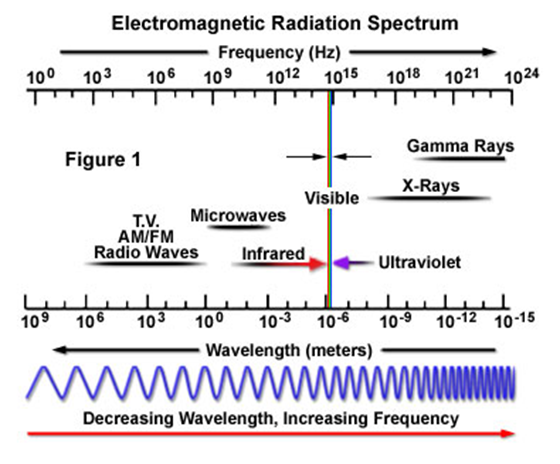 (Original source is uncertain).