
This is perhaps the most important series in this entire collection of blogs. The Creation Event provides an amazing and “eye-opening” aspect of God and this universe we call “home.”. I am sure, from over 14 years of teaching, that many readers will finish this series amazed both at God, and sadly, at Satan’s deception. And that leads to the next point.
Few other topics ignite such volatility and diversity within the church. Teachings range from the six, 24-hour creation day period (Genesis 1) to the Big Bang. We will initially address Creation through Scripture, and then consider the observations from science. We will also examine the historical origin of the Big Bang theory, its content, and its relevance to the Creation Event from Scripture.
Hang in there… and be amazed!
* * *
When teaching this lesson in a church setting, I begin with Scripture and ask the class to share their perspective on the origin of the universe. The class invariably opens with Genesis 1 and we begin a journey through the chapter . . . until I interrupt their discussion and ask the class to return and re-read Genesis 1:1:
Genesis 1: 1
“In the beginning, God created (“bara-ed”; spoke/poofed into existence, from nothing) the heavens and the earth.”
We discuss “bara” and its implication – heaven and earth were both spoken into existence from nothing. Then I remind the class of Isaiah 45:18 and we read and discuss it:
Isaiah 45:18
For this is what the Lord says – He who created (bara – spoke into existence from nothing) the heavens, He is God; He who fashioned (yatsar – to squeeze/mold into shape, esp. as a potter) and made (asah –to make; from pre-existing material) the earth, He founded it (kuwn – arranged / established): He did not create (bara – spoke) it to be empty, but formed (yatsar – potter) it to be inhabited.
Isaiah clearly states that Earth was not “spoken” into existence as an empty planet, but rather sculpted into a unique planet, specifically to host life.
Again, the class is reminded that we’ve noted this apparent conflict/contradiction between Genesis 1 and Isaiah 45 in previous lessons, and that we would eventually resolve the mystery. Finally, the time has come.
A Conflict in Scripture?
No! But we must look at the larger picture. Consider the following verses:
- Genesis 24:3 – that I may make you swear by Yahweh, the God of heaven and the God of earth….
- Deuteronomy 3:24 – …for what god is there in the heaven or on the earth who can do according to your works…
- Deuteronomy 4:26 – I call to witness against you today the heaven and the earth, that you will perish…
- Deuteronomy 32:1 – Give ear, O heavens, and I will speak, and let the earth hear the words…
- I Chronicle 16:31 – Let the heavens rejoice, and let the earth be glad…
- Ezra 5:11 – …We are servants of the God of heaven and earth…
- Psalm 69:34 – … Let heavens and earth praise him, the seas and everything that moves in them…
- Psalm 148:13 – …let them praise the name of Yahweh… His splendor is above earth and heavens.
What comes to mind when you consider the words “heavens” and “earth” in the previous verses? And, by the way, these two words are included together in 526 Old Testament verses… Any idea why this combination would be used so frequently?
The words “heaven and earth” referred to the totality of God’s creation—the “universe” as we would say it today. There was no Hebrew word for “universe” in the ancient language. So, with this information, now contemplate Genesis 1:1 when coupled with Isaiah 45:2.
Scriptures’ Perspective on the Creation Event
Hopefully, you now recognize that “in the beginning” (Genesis 1:1) God spoke into existence everything the universe contains today – nothing has been added or removed. (We’ll discuss this later; for now, we stick with Scripture.) But Isaiah provides more detail and makes it clear that God did not “barah” the earth individually but sculpted this world to make it habitable. And that raises another question:
When did “barah” stop, and “yatsar/asa” begin?
Scripture makes no specific mention, but we find a clue in the book of Job that we’ve considered before:
Job 38:33
“Do you know the ordinances of the heavens, or fix their rule over the earth?” (NASV)
or
“Do you know the physical laws of the universe and how to control the earth through them?” (NLT)
Job had become angry and disrespectful of God in Chapter 38. God quizzed Job to humble him and demonstrate His sovereignty—and He used creation to do it. God clearly states in Job 38:33 in the New Living Translation (NLT) that He controls the earth through the physical laws of the universe—laws for things like gravity and angular momentum. This also suggests that God formed and sculpted the earth through His natural laws, i.e. through natural processes, after they were established during the Creation Event.
Finally, we must consider one more logical question raised by Scripture:
If God did not “barah” the earth, then what was the “pre-existing substance” that He sculpted the earth from?
Again, Scripture is silent, but God gives us a clue from another question in His dialogue with Job:
Job 38:8,9
Who shut up the sea behind doors when it burst forth from the womb, when I made the clouds its garment and wrapped it in thick darkness?
And also:
Genesis 1:2
And the earth was formless and void, and darkness was over the surface of the deep…
Formless, void, wrapped in darkness and with clouds as its garment—that was our infant Earth either prior to or during its “sculpting” by God, likely through His natural laws and processes. But what was the material? Again, these verses provide hints, but the question remains largely unanswered.
We’ve reviewed several important scriptures in this section that clearly reflect God as the author of creation; they also provide framework for the Creation Event. However, some details are not addressed through scripture. But God provided another source of information— “what has been made” (Romans 1:18-22), the third leg of our stool. He told us to “look and understand it” to learn more about Him. And that’s what we’ll do!
Nature’s Perspective on the Creation Event
Scientists have studied nature’s night skies in detail for the past two centuries. The invention of the telescope birthed discoveries that eventually became the science of astronomy. According to Psalms 19:2, the discoveries were ordained by God to help us learn more of Him—we’ve considered this Scripture in previous blogs:
Psalms 19:1,2
The heavens are telling of the glory of God, and the expanse is declaring the work of His hands.
So, let’s examine what the astronomers and astrophysicists have discovered in the heavens that address our questions about the solar system, sun, and early Earth during the Creation Event.
The Eagle Nebulae1 is a gigantic cloud of dust within our galaxy, about 6800 light years from earth. Scientists have studied and photographed it through the Hubble Space Telescope since 1995 (Figures 1-5). Its incomprehensible complexity, mysterious composition of dust and hydrogen bathed in UV light, and its size speak of God’s power and wisdom. It is also the birthplace of new stars (see captions on Figures 1-5) which are visible as small “knobs” on the Pillars of Creation (Figures 4 and 5). Notice the stars themselves are not visible because the dust is opaque. They are literally “wrapped in darkness and with clouds (dust) as their garments” (Psalms 19:2).
A simplified model2 for star (and planet) formation is diagrammed in Figure 6. Gravitational collapse of an isolated dust/hydrogen cloud produces a spinning, circular disc through angular momentum. With further collapse, the center of the disk eventually ignites via atomic fusion as a protostar is formed. As the star stabilizes, the remaining dust and debris eventually form planets through gravity and collisions.
Creation: An Initial Summary From Scripture and Nature
This Part 1 introduction to the Creation Event has likely rocked you and perhaps even disturbed you. And that is precisely why this blog series is so critically important.
We first progressed through the creation scriptures (above), using accurate Hebrew verb translations, while contrasting Genesis 1:1 and Isaiah 45:2. It leads to a very different “Day 1” interpretation than presented in most classroom Bible studies.
We then looked at nature, or “what has been made” (Romans 1:22). Observations by the Hubble Space telescope reveal how God’s “natural laws govern the universe” (Job 38:33) and are currently forming distant stars and planets. And although this process is a very different model from most Bible classroom discussions, the scriptural definition of an early earth “wrapped in thick darkness with clouds as its garment” (Job 38:8,9) is precisely what we see (as protostars and their future planets) in God’s creation.
So, we face a big question. How do we explain the Creation Event with a model that consistently honors both Scripture and our observations of current star formation? Did the scientists get it right with their “Big Bang” model? That’s our next topic in Part 2.
1 Wikipedia; Eagle Nebulae; https://en.wikipedia.org/wiki/Eagle_Nebula
2 Wikipedia; Protostars; https://en.wikipedia.org/wiki/Protostar
Figure 1. Eagle nebula captured with a Celestron cpc1100 from the Israeli Desert by Deddy Dayag.
From Wikipedia Commons.

Figure 2. Three-colour composite mosaic image of the Eagle Nebula (Messier 16, or NGC 6611), based on images obtained with the Wide-Field Imager camera on the MPG/ESO 2.2-metre telescope at the La Silla Observatory. At the centre, the so-called “Pillars of Creation” can be seen… This image is a composite of 3 filters in the visible range: B (blue), V (green) and R (red). Author: ESO – http://www.eso.org/public/images/eso0926a/
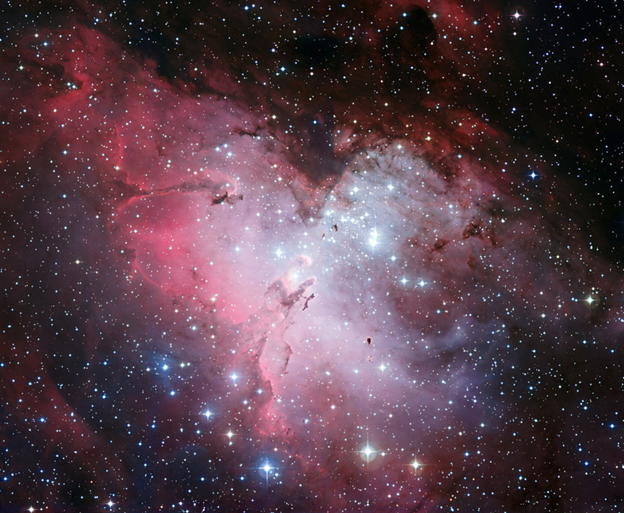
Figure 3. Reference map showing locations of well-known areas within the Eagle Nebulae, including the “Pillars of Creation” shown below in Figures 4 and 5.


Figure 4. NASA’s Hubble Space Telescope has revisited the famous Pillars of Creation, originally photographed in 1995, revealing a sharper and wider view of the structures in this visible-light image…The towering pillars are about 5 light-years tall… The new image was taken with Hubble’s versatile and sharp-eyed Wide Field Camera 3. The pillars are bathed in the blistering ultraviolet light from a grouping of young, massive stars located off the top of the image. Streamers of gas can be seen bleeding off the pillars as the intense radiation heats and evaporates it into space. Denser regions of the pillars are shadowing material beneath them from the powerful radiation. Stars are being born deep inside the pillars, which are made of cold hydrogen gas laced with dust. NASA, ESA, and the Hubble Heritage Team (STScI/AURA) – http://hubblesite.org/image/3471/news_release/2015-01

Figure 5. STScI-1995-44 Star-birth clouds in M16, taken from NASA’s Hubble Space Telescope (HST) with its Wide Field/Planetary Camera 2 (WFPC2): Stellar “eggs” emerge from molecular cloud. This eerie, dark structure in IC 4703 (the Eagle nebula) is a column of cool molecular hydrogen gas and dust that is an incubator for new stars. The stars are embedded inside finger-like protrusions clearly seen extending from the top of the column. Each “fingertip” is somewhat larger than our own solar system. The pillar is slowly eroding away by the ultraviolet light from nearby hot stars, a process called “photoevaporation”. As it does, small globules of especially dense gas buried within the cloud are uncovered. These globules have been dubbed “EGGs” ; an acronym for “Evaporating Gaseous Globules”. The shadows of the EGGs protect gas behind them, resulting in the finger-like structures at the top of the cloud. ST ScI OPO • PRC95-44b. From: Jeff Hester and Paul Scowen (Arizona State University), Hubble Space Telescope, ESA, STScI, and NASA – http://hubblesite.org/newscenter/newsdesk/archive/releases/1995/44/image/b

Figure 6. Simplified star formation model. Gravitational collapse of a dust cloud and angular momentum produce a disk of dust and hydrogen gas. Additional collapse promotes ignition of the center as a young star is born. The Hubble telescope has captured images of these early stars and dust clouds—termed proplyds. The remaining dust and debris eventually collapse and form orbiting planets.
