
In Part 1, I shared about my (and others’) confusion with the teachings on evolution in graduate school paleontology classes at Texas A&M. Paleontology is the study of fossils in ancient rocks. The following is my portrayal of a scene that occurred during one of those classes:
Student A: You instructed us on Darwin’s evolutionary model—that his theory predicts gradual change in animal body types. That seems inconsistent with the rapid appearance of completely new body types at boundaries in the geologic strata.
Professor (typically warm and open to questions): We don’t know how much time elapsed at those boundaries. And we don’t have enough fossil types below those boundaries to see the changes (in an abrupt and defensive tone). That DOESN’T negate the evolutionary process.
Student B: But you said we would see transitional fossils from evolutionary change, why wouldn’t they be most obvious just below the boundaries?
Professor (now agitated): I’m not spending any more class time debating “if” evolution occurs. It’s obvious throughout the fossil record. And when you advance in your education you’ll see and accept it.
I’m sure that’s not exactly verbatim… but you get the idea.
Charles Darwin’s theory of evolution was not taught as “theory” at Texas A&M during the mid-1970’s. I’ve heard it said that the only “theoretical” part is the origin of life itself. Macroevolution was taught and defended as fact. Another lesson I learned was how large a powder-keg the topic of evolution could become among those who support it in an academic environment.
A list of the “proofs” of evolution was provided in one course. The topics seemed daunting and overwhelmingly supported macroevolution. As graduate students, we had very limited time and scant resources to evaluate the information. That was about 45 years ago. I wonder how many of my classmates simply “drank the Kool-Ade” and accepted macroevolution with no further evaluation of those topics. Today, almost a half-century later (it’s hard to imagine!) those same topics scream for assessment through the light of more recent discoveries.
Macroevolution—the Pros and Cons
This section is not intended to prove or disprove macroevolution. As stated in Part 1, I’m not a biologist—the counterarguments by an evolutionary biologist would certainly provide further context. Rather, it’s my intent to provide the list of “proofs” from graduate school and objectively address the pros and cons of each topic with current data. The list is provided below as macroevolutionary “Pros:”
Macroevolutionary “Pros”
- Microevolution (Adaptation, Natural Selection)
- Homologies
- Embryonic Similarities
- Origins / “Little Warm Pond” (Stanley Miller Experiments)
- Fossil Record
Charles Darwin’s model, when coupled with these assertive “Pros” appeared to be an iron-clad argument in support of evolution during the 1970’s. Each topic seemed like an insurmountable mountain for those of us with scriptural uncertainties and/or technical questions regarding the concepts. But now, half a century later, a list of macroevolutionary “Cons” exist as well, listed below:
Macroevolutionary “Cons”
- Microevolution (Adaptation, Natural Selection)
- Homologies
- Embryonic Similarities
- Origins / “Little Warm Pond” (Stanley Miller Experiments)
- Fossil Record / Cambrian Explosion
- Cellular Complexity
You might be surprised to see the same five “Pros” listed under the “Cons” list, and the addition of another item as well. Fifty years of research have had an impact—two of the “iron-clad” arguments have been negated, and questions/concerns swirl around two others.
I’ll step through each of these items and address its “pro” and “con” status in the following sections of Part 2 and beyond.
Microevolution (Adaptation, Natural Selection)
At first glance, two items on the “Pro” list might seem to support macroevolution. The first item is microevolution—we discussed it in Part 1 (Blog #25). Changes within a species clearly occur, even from generation to generation, in response to survival pressures upon the population. Some changes are due to beneficial mutations. Darwin hypothesized that the progressive and cumulative effects of these tiny changes would eventually lead to new orders and families of organisms.
There is no doubt that changes occur within species—perhaps even leading to new species. In Part 1 I mentioned my dismay at seeing the morphology of the same microfossil specie gradually change when moving upward in an oil well core (vertically, to younger sediment). I also mentioned how the professor victoriously pronounced it as “proof of evolution.”
So, here’s the conflict with microevolution as a “proof.”. At some point, the required changes within the members of a population exceed the natural diversity within their DNA. Beneficial mutations are required for further, progressive changes leading to new characteristics. (Figures 1-3 include selected text from technical summary articles that discuss mutations in more detail, and specifically focus on the COVID-19 virus.)
The mutation rate is the problematic issue. Generally, the smaller the genome, the faster the mutation rate.1,2,3 (A genome is the complete set of DNA instructions found within a cell.) The relationship is shown in Figure 3. The mutation rate for the simplest of “organisms” (a virus with Viroid RNA) is approximately 10-2.5. In other words, a Viroid RNA has a mutation frequency of approximately .003, or approximately one mutation in every 333 replications (or reproductions). In contrast, the mutation rate for a mouse is 10-10.5, about eight orders of magnitude slower.
Why is this significant?
The text in Figure 2 states that because of the rapid replication of the COVID-19 Viroid RNA, it mutates about once every seven days. How does this contrast with a more advanced organism—a chimpanzee, for example? Recent studies suggest the gene sequences of a chimpanzee and a human have an 85% similarity,4,5 or a 15% difference in the gene sequences. How long would it take to implement just a 1% change in the gene sequences of a mammal (using a very liberal rate of 10-9)? Given this accelerated mutation rate, scientists calculate that only a 1% change would still require 10 million years, and many more millions of years for a 15% change in the gene sequences to evolve a human from a chimpanzee. That is a nonsensically long time. I’ll share in a later paper how the fossil record at one location suggests that suites of completely new organisms simply “appear” in the geologic column in less than 410,000 years!
To summarize, microevolution certainly drives change at the species level. But to progress that change to levels that ultimately drive macroevolution is very difficult to reconcile. The extremely slow mutation rates in organisms with higher genome numbers—like dinosaurs and mammals—require much longer time periods than what the fossil record suggests. We’ll examine the fossil record later.
Homologies
This is the other item on the “Pro” list that seems logical as a “proof” of macroevolution. I remember thinking after I first heard homologies discussed, How can you argue against it? Let’s look deeper.
What do the organisms in Figure 4 have in common?
They are all mammals with many similarities: Warm-blooded, hair, they feed their young via lactation, etc. Evolutionists believe the similarities reflect descent with modification from a common ancestor. Now let’s look at the internal similarities.
What do the organisms in Figure 5 have in common?
The forearm structure with wrist bones and five digits is termed a “homology”—a similar structure in various organisms that serve different purposes. The “hand” structure promotes flight in a bird and bat, crawling with a lizard, swimming with a whale, and multiple functions in a human. Evolutionists promote homologies as “proof” of evolution from a ancient common ancestor. It is compelling evidence, but are there other possibilities?
The evolutionists’ explanation goes back to the Devonian Period 420—360 million years ago, when the tetrapods (four-legged organisms) first appeared (a.k.a. “evolved”) in the geologic fossil record.6 Many of the first tetrapods had various numbers of digits on their “hand” structure—up to 13 in some cases. By the end of the Devonian the number of digits had stabilized at five and have remained intact since that time. When asked if five digits were better than any other number of digits, the response is:
“Any hypotheses would be highly speculative without a lot of data on the types of selective pressures organisms at the time were facing… we simply don’t 100% know the ‘why’ or ‘how’ of the narrowing of hand morphology to five-digit rays in the Devonian.…” 7
So, there you have it. Biological evolutionists acknowledge that by the end of the Devonian the “hand” structure had five digits, the structure remained consistent through time, and they don’t fully understand the reason for “why” five digits were selected.
Far be it from me to critique a biological debate, but I thought that Darwinian evolution secured a competitive advantage for the successive generations. It seems reasonable to this “non-biologist” that there must have been an advantage or greater efficiency with the five-digit design.
And that leads us to the other argument.
What if the tetrapods arrived in the early Devonian through the hands of a Creator and faced pressures during that early transitional time that favored multiple digits (five and other numbers)? And, after the introduction and eventual stability of the tetrapods, the Creator implemented the most efficient and functional design (five-digit, hand-like structure) into all tetrapods, and eventually all other advanced organisms thereafter?
In other words, many believe the five-digit homology is the most efficient design for advanced organisms, that it was globally implemented by a single Designer, and hence, are fingerprints of the Creator Himself through time.
In summary, I consider homology as the strongest, legitimate evidence of macroevolution. It must be an exceedingly persuasive argument for a scientist with no belief in God. In fact, the only legitimate “Con” to this “proof” in my opinion requires an opposite world view—the insertion of a God into His creation, and a belief that the Creator selected and emplaced the optimal and most efficient design criteria. As the result, He could examine His creation at each step, and upon completion, truthfully proclaim, “It is very good!” (Genesis 1:31).
1Carbon Health Editorial Team; Carbon Health; COVID-19 Mutations: Why They Occur and What They Mean for the Future, (March 9, 2022). https://carbonhealth.com/blog-post/covid-19-mutations-why-they-occur-and-what-they-mean-for-the-future
2The University of Bath; Phys Org; Mutation Rate of COVID-19 Virus is at Least 50% Higher Than Previously Thought, (August 27, 2021). https://phys.org/news/2021-08-mutation-covid-virus-percent-higher.html
3PLOS Biology; Journals.PLOS.Org, Why Are RNA Virus Mutation Rates so Damn High? https://journals.plos.org/plosbiology/article/figure?id=10.1371/journal.pbio.3000003.g001
4Marks, J. (2003); What it Means to be 98% Chimpanzee: Apes, People, and Their Genes; University of CA Press; 336 pp.
5Rana, F., Ross, H. (2005); Who Was Adam?: A Creation Model Approach to the Origins of Man; NavPress Publishing Group; 299 pp.
6SBS: Ask Evolution: Why Do We Have Five Fingers? (August 1, 2016) https://www.sbs.com.au/topics/science/humans/article/2016/08/01/ask-evolution-why-do-we-have-five-fingers
7Adams, J. (2016); Paleontologist at Monash University (quoted in Reference #6, above).
Figure 1. Research article excerpts: See Reference #1 (above)
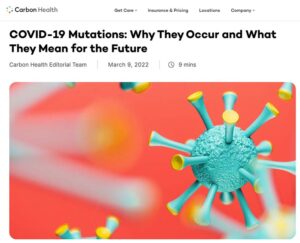
Figure 1 (continued)
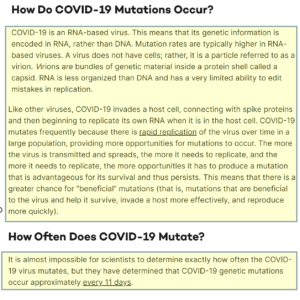
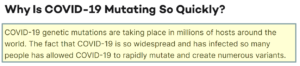
Figure 2. Research article excerpts: See Reference #2 (above). https://phys.org/news/2021-08-mutation-covid-virus-percent-higher.html
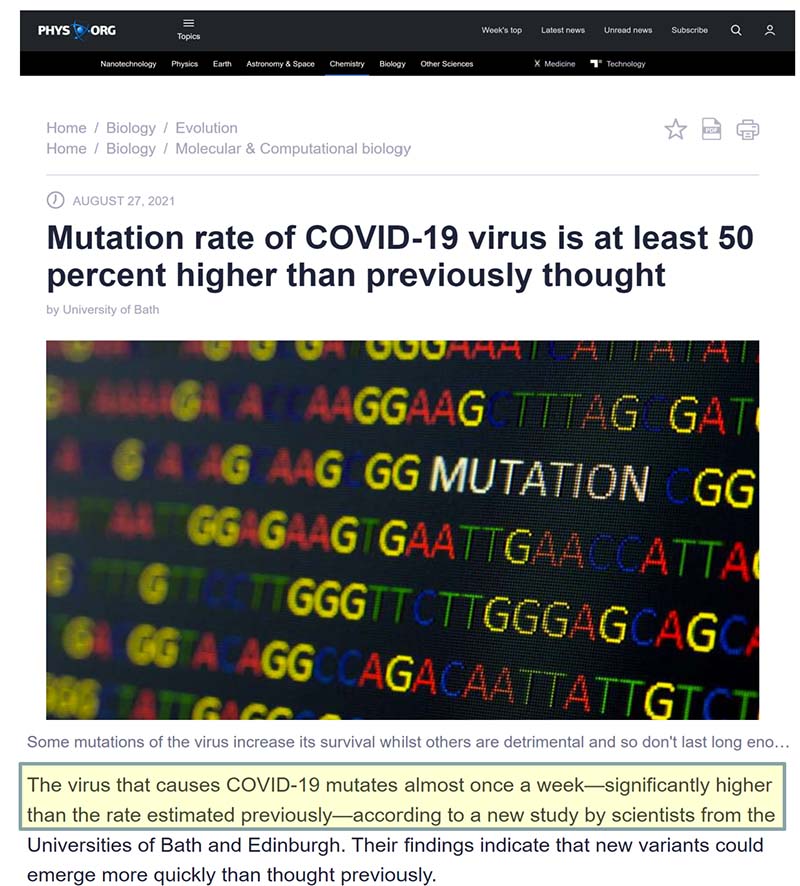
Figure 3. Research article excerpts: See Reference #3 (above).
https://journals.plos.org/plosbiology/article/figure?id=10.1371/journal.pbio.3000003.g001

Viroid RNA is the shorter red arrow

Figure 4. Organisms with similar attributes.



Figure 5. An example of a common biological homology.
