Welcome to Part 2 of The Creation Event series. You might have finished Part 1 a bit dazed, bewildered, or possibly disturbed. We contrasted two creation scriptures using accurate verb forms and came to a very different conclusion about the Creation Event than what is often taught from Genesis 1:1-3. We then followed the directions in Romans 1:18-23 and observed God’s creation through astronomy. It, too, suggests a different Creation mechanism than that typically considered in a church classroom.
And now we’re left with the question, “What is the most accurate Creation Event model that agrees with both Scripture and God’s observed Creation?” Did the scientists get if right with their Big Bang model? That’s the topic of discussion in Part 2.
* * *
I mentioned in Part 1 that when teaching this lesson, I initially ask the class their interpretation of the Creation Event. Later, I ask a second question and record their answers on a white board:
“What do you know, or what have you been taught about the Big Bang?”
How would you answer it? Each class invariably recants the same three to five answers:
- Scientists say it’s a giant explosion and all the stars and planets formed from the residue;
- It’s a godless explosion—scientists use it to eliminate God from their models;
- Scientists promote the theory because it provides the vast time required for evolution;
- Scientists only work with the data and never acknowledge God’s part in creation;
- It’s the scientists preferred, go-to mechanism to explain how the universe began.
Do these answers sound familiar?
If so, this blog series is for you. Please read each Part. If you do, I can almost assure you a shocking experience regarding what the historical references and scripture reveal. Again, please hang in there! We started with Scripture and went to the heavens (“what has been made”) in Part 1. We’ll begin with the heavens and finish with Scripture in Part 2.
* * *
The Big Bang—Historical Beginnings
A transition occurred during the mid-1800’s, especially following Darwin’s theory of evolution. Many scientists up to that time were educated in Christian universities, and/or followed the Christian faith. Afterwards, increasing numbers of scientists held agnostic or atheistic views. Many of those in the latter 1800’s and into the 1900’s also adopted the Kant-Newton Infinite Universe model. This view assumed the universe is static and infinite in space and time. In other words, when astronomers looked at images like Figure 1 (our neighboring Andromeda galaxy), they assumed the stars continued infinitely. And, since infinite time was also assumed, highly improbable events like the origin of life were destined to eventually occur. This completely removed God from their picture.
In 1915, Albert Einstein published his Theory of General Relativitiy1. It included a series of field equations which specify how the geometry of space and time is influenced by whatever matter and radiation are present. The equations are horrendous to solve (Figure 2). In 1917, he applied the equations to the universe as a whole—and hit a snag. His equations suggested the universe was expanding. Einstein, as most astronomers of his time, assumed a static and infinite universe, so he added a “cosmological constant” to his equations to eliminate the expansion. He later declared the cosmological constant as “the biggest blunder of his life.” 1
Edwin Hubble made the next major discovery.2 As we discussed in Blog #17, A Matter of Time: Truth Through Creation – Astronomy (Part 3b) , Hubble published his “Redshift-Distance Law” in 1929. He applied Vesto Sliper’s observation (more distant objects appear to have greater redshifts) with his own measurements from 46 distant galaxies. Hubble then defined a relationship between each galaxy’s redshift and its “recessional velocity” (the velocity the galaxy appears to be traveling away from earth); hence, the further the galaxy has traveled away from earth, the greater its velocity and redshift. However, as Hubble discovered (Figure 3), practically every viewable galaxy is moving away from earth.
Hubble and others recognized what this meant. If every galaxy is moving away from earth, then the galaxies must also be moving away from each other—in other words, the universe is expanding just as Einstein’s initial equations indicated.3 Space itself was stretching.
How can this be? Consider Figure 4. If you paint dots (to represent galaxies) on a balloon, and then blow up the balloon, the dots move further apart. The space between each dot expands, or “stretches out.” It’s a great analogy for the galaxies throughout the universe. It also explains why the redshift measurements were critically important—they measure/reflect the ”stretching phenomenon.” And, it was not an explosion, but rather a universal expansion event.
The Big Bang—What It Meant
Einstein, Hubble, and most other astrophysicists recognized the astounding consequences of an expanding universe. If the galaxies are moving apart, they are moving apart from a “beginning.” And if there was a “beginning,” then there must be a “Beginner.” Hubble’s Redshift Law implied the universe was not static… and a firestorm broke out in the scientific world of the 1930’s. We’ll spend more time with the scientists’ responses in Part 3 of this series. For now, let’s look deeper into what this expansion event included.
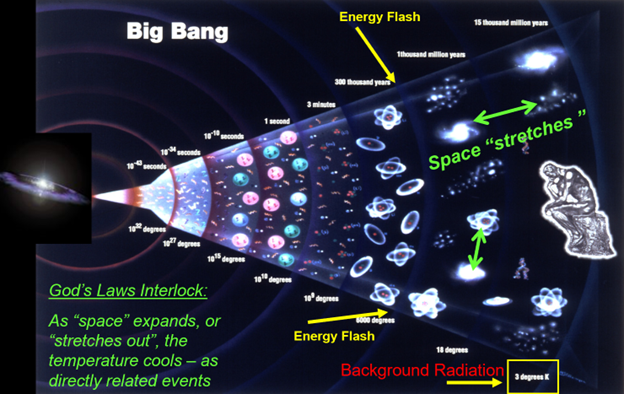
Almost immediately, the scientists began developing complicated astrophysical models that ran backwards in time—back to a “beginning.” Many of the models were developed with an intent to disprove the expansion event and return to a static model. And their efforts continue to this day. Figure 5 shows a current diagram of how the expansion event progressed based upon years of intense modeling and natural observations.
So, what happens when the clock runs backwards? The models predict that the expansion began about 14-15 billion years ago (see Figure 5). Moving backwards in time toward the starting point (we’ll call it the “Beginning,”) space shrinks, and mass and energy are packed increasingly closer together. The temperature increases exponentially, from today’s temperature in deep space (at -270°C), to 6000°C at 300,000 years after the Beginning, to 10 billion degrees one second after the Beginning.
So, what happened at the Beginning according to their models?
Before the Beginning was “nothingness” (try to get your mind around that). At the Beginning, four entities came into existence at a single point: mass, energy, space, and time. Sound familiar? This is Einstein’s famous equation from his Special Relativity Law:
E = mC2 (C = speed of light; distance/time)
Time and space are interlocked—so as time progressed from the Beginning, space also expanded and the temperature decreased. Today’s temperature is at -270°C and still decreasing; the age is about 15 billion years and still increasing; and, outer space is larger than we can comprehend and still expanding, or “stretching out.” Remember that phrase.
The Big Bang—Scriptural Implications?
I mentioned earlier that we would begin with the heavens and end with Scripture. You may be totally blasted at this point and believe that all astronomers and astrophysicists are crackpots. Much information has been provided—I understand your weariness. However, we must check the Big Bang model against Scripture.
Please, in your weariness, consider the following verses:
Isa. 45:12
It is I who made the earth and created mankind upon it. My own hands stretched out the heavens; I marshaled their starry hosts.
Jer. 10:12
But God made the earth by His power; He founded the world by His wisdom and stretched out the heavens by His understanding.
Isa. 40:22
It is He who sits (is enthroned) above the circle of the earth, and its inhabitants are like grasshoppers, Who stretches out the heavens like a curtain and spreads them out like a tent to dwell in.
Ps. 104:1-2
. . . Thou art clothed with splendor and majesty, covering Thyself with light as with a cloak, stretching out heaven like a tent curtain.
I hope these verses shocked you, like they did me after learning what the “Big Bang” theory actually includes. Why would God emphasize this aspect of the heavens, the “stretching out,” in four different Old Testament books if it wasn’t significant?
But perhaps there is also another reason. It’s captured by one of my favorite verses and we’ve viewed it many times in these blog series:
Ps. 19:1-2
The heavens are telling of the glory of God; the expanse (empty space, JRC) is declaring the work of His hands.
I’ve promised in several previous papers that we would reach a point where the second half of this verse, specifically “how heaven’s empty space testifies to the work of His hands” would become evident. We’re there now.
The redshift from empty space declares that the expanse is stretching away from a beginning—the Creation Event, and the “work of His hands.“ At this very moment, if you measure the light spectrum from any distant galaxy, you visibly witness a spectrum that is “stretched” toward the red end. It testifies to a beginning… and that requires a “Beginner.”
1 Wikipedia; General Relativity; https://www.nasa.gov/analogs/nsrl/why-space-radiation-matters
2Wikipedia; Edwin Hubble; https://en.wikipedia.org/wiki/Edwin_Hubble
3Wikipedia; Big Bang; https://en.wikipedia.org/wiki/Big_Bang
Figure 1. The Andromeda galaxy – our nearest neighbor. The early astronomers assumed the galaxy was a “nebulae” of distant dust and gas, and that the surrounding stars extended into infinity. In his studies of this feature with the giant, and newly constructed Hooker Telescope in the early 1920’s, Edwin Hubble formulated that Andromeda was actually a giant collection of stars, and that the surrounding stars were those from our own “galaxy” – the Milky Way. Photo from Wikipedia: Andromeda Galax,y with photographic details and credit to David Dayag

Figure 2. From Wikepedia1 – These equations specify how the geometry of space and time is influenced by whatever matter and radiation are present, and form the core of Einstein’s general theory of relativity. . . The Einstein field equations are nonlinear and very difficult to solve. And, they point to an expanding universe.

Figure 3. An early telescopic photographic plate of deep space showing the abundant galaxies that surround us, and each one with a redshifted light spectrum.

Figure 4. A simple representation of “expanding space.” The distance between the “galaxies” drawn on the balloon expands with the balloon, just as the space between the galaxies in our universe is expanding, as measured by the redshift.

Figure 5. A simplified diagram of the expansion event, referred to by scientists as the “Big Bang.”