
Part 1 of this blog addressed two Christian views regarding science and the Bible (the first two from the following list). In Part 2, we discuss the third view and answer the question, “Are science and the Bible aligned?” Which one of the three views best mirrors your belief?
Is it:
- Science versus the Bible;
- Science or the Bible; or,
- Science and the Bible
For the past 15 years I’ve taught the Science and the Bible course at church congregations in Alaska, California, and Texas. Many students enter the class assured that science is corrupt, and “That all scientists are atheists.” I ask every student to fill out a questionnaire in the first class. The following chart summarizes the results from the past 15 years of cumulative survey data:
Percentage of Students
~60%
~10%
~30%
“Age of Earth View / Perspective”
Young Earth / Science versus the Bible
Uncertain / Science or the Bible(?)
Old Earth / Science and the Bible
Over half of the students begin each course with a Young Earth view and the perspective that science contradicts (opposes) the Bible. As discussed in Part 1, this often leads to an adversarial attitude towards science. A smaller population (~10%) is typically uncertain about the earth’s age, unsure of the relationship between science and the Bible, and they question science—the second listed view.
The remaining students typically hold an Old Earth view and believe that science and the Bible generally agree. Over the past 4-5 years, the Young Earth and Old Earth ratio in our former California congregation appeared to be leveling (50:50 ratio). Part 2 examines this third view.
Science and the Bible
A major emphasis of meteorological research (the study of weather) in 1955 was long-term weather forecasting. Ed Lorenz—a meteorologist and mathematician—was a professor at the Massachusetts Institute of Technology (MIT) during this period. His research addressed a basic question: “How far into the future can we accurately predict the weather?”1
As a meteorologist, Lorenz understood that several complex, integrated processes such as the convective rise of warm air, condensation, and atmospheric circulation control the weather. As a mathematician, he could describe these processes with 12 complex, non-linear equations. However, to link and execute his equations with real atmospheric data required a computer—and that was a problem. The primitive computers of the mid-1950’s had less numerical processing power than our current hand-held calculators.
Several hours were required to complete each of his computer program runs; nevertheless, his encouraging results appeared to reproduce global weather patterns. For example, the wind direction would swing from north to south over multi-day periods; storms would form; temperatures would cycle.
One day Lorenz decided to re-run an earlier model and began near the mid-point of the former run. Instead of re-entering each six-digit decimal number, he simply rounded each number up to the third decimal (to the thousandth decimal place).
He hit the start button and left for a coffee break.
The results confounded Lorenz upon his return (Figure 1). The output initially duplicated his previous results but then diverged into a completely different pattern. His tiny, rounding discrepancies in the second run led to hugely different results from the first run. He had discovered a new branch of mathematics now referred to as deterministic chaos, or simply, “chaos.” His discovery doomed long-term weather forecasting. We cannot measure the starting parameters (temperature, humidity, etc.) accurately and densely enough to satisfy the set of equations.
Lorenz summarized and published his results with the title, “Can the Flap of a Butterfly’s Wings in Brazil Set Off a Tornado in Texas?” This became known as the “Butterfly Effect.” A graph of the results from his simplified model (using only three equations) is shown in Figure 2, which by a remarkable coincidence, resembles a butterfly.
Figure 1
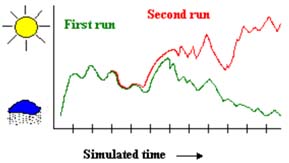
Figure 2
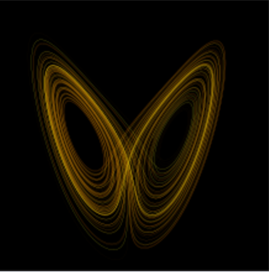
Figure 1. Example of the divergence between Lorenz’ original and repeated modeling runs.
Figure 2. Graphical plot of data from Lorenz’ simplified “three-equation” model.
* * *
Why reference “Chaos Theory” with respect to creation and the Bible? At first glance, the topics “Chaos” and “the Bible” seem to be at odds.
Prior to Lorenz’ research, local and global weather systems were assumed to randomly change over a season. Lorenz demonstrated that the global weather system is not random; rather, a complex suite of natural processes is at work. He identified a deep, underlying order that we can numerically mimic, but not predict. Since then, non-linear processes (with underlying order) have been identified in other “randomly-assumed” natural systems. Consider the following examples:
- Frequency of the lemmings’ “march to the sea”
- Heartbeat arrythmia
- Predator/prey population cycles
- Coastline geometries
- Vein and artery distributions within the body
- Weather
- ???
So, what’s the point?
These examples provide insight to another of God’s invisible attributes (Romans 1:23). He is the Author of order, and not confusion, as per the following verse:
“God is not a God of disorder (confusion) but the God of peace (or order).” (1 Corinthians 14:33).
As shared earlier, Scripture states that creation is by God and reflects His attributes and power (Psalm 19:1, Romans 1:18-23). The book of Job goes further and explains that He also established our natural, physical laws. Job states that God governs all of creation, and specifically the earth, through these laws (verses shared below). They provide the universal fabric of order, stability, and predictability required by mankind. Let’s examine a few verses to better appreciate God’s fingerprints within His creation.
* * *
In Job 38-40, God expressed His sovereignty by quizzing Job over the disciplines of science—physics, geography, meteorology, oceanography, and biology. God focused on astronomy in the following text:
“Can you bind the chains of the Pleiades, or loose the cords of Orion? Can you lead forth a constellation in its season, and guide the Bear with her satellites? Do you know the ordinances of the heavens, or fix their rule over the earth?” (Job 38:31-33; New American Standard Version).
These verses contain amazing insights that poor Job could never have grasped—and some we’ve only recognized in the last few decades. Let’s dig a little deeper to better appreciate God’s invisible attributes through His physical laws that govern creation.
“Can you bind the chains of the Pleiades?” The “Pleiades2” is a small constellation as viewed from the earth. My grandmother used to call it the “Seven Sisters.” It was a favorite constellation as a child, but now, five decades and several pairs of glasses later, I can’t even see the small, individual stars.
But that’s what it is . . . a cluster of seven small stars visible by naked eye from the earth (Wikipedia: “Pleiades”). However, technically speaking, they are seven members of a much larger cluster of about 1000 young, hot and blue stars only about 400 light years from earth (see Figure 3). They were likely formed by a single event, such as a nearby supernovae (an exploding star). They travel together at the same speed and direction, “bound together” through the chains of gravity.
Gravity is one of God’s basic “forces” that we can mathematically describe with great accuracy; yet we are still perplexed by aspects of its source and nature. Gravity holds our galaxy of stars together, it locks earth’s orbit about the sun, and it grips our atmosphere to the earth’s surface, along with the oxygen that we breath. Without it, humankind would vanish.
Can you . . . loose the cords of Orion? Another staggering question from God regarding astronomy, and this one contrasts with the Pleiades (above). Those chains were bound; the cords of Orion3 were loosened.
The Orion constellation is a collection of stars of great diversity and huge distances from one another. Orion “appears” as a constellation by its random distribution of stars when viewed from the earth [Figure 4a; Wikipedia: “Orion (constellation)”]. The stars are NOT associated with one another; in fact, they move in different directions at different speeds. The red giant star, Betelgeuse, makes up Orion’s right shoulder (Figure 4b). It is suspected to have once been associated with the small cluster in Orion’s belt but has since slipped away to its current location. The “cords” of gravity have indeed been loosened – the stars are moving independently of one another, unconstrained.
Do you realize what God revealed in Job 38:31? He contrasted two constellations of stars—one cluster chained together by gravity, and the other a collection of independent stars—unbound, or generally “loosened” from gravity. And He emphasized this difference over 3000 years ago, long before telescopes and the field of astronomy. You just can’t make these things up!
Can you lead forth a constellation in its season, and guide the Bear with her satellites? With this “heavenly” question, God shifted His emphasis to earth. The consistent, seasonal march of the constellations, including “the Bear,” reflects both the annual orbit of the earth about the sun and earth’s seasonal tilt upon its axis. God’s question to Job on the “march of the constellations” addressed the physical laws of Earth’s planetary motion and its unusual axial stability.
The earth is unique with respect to most other planets—we have a very large moon. Its gravitational effect upon the earth stabilizes our axial tilt. Hence our seasons are extremely stable, repeatable, and predictable. Most other planets wobble erratically. God insured that we have the repeatable “seasons” we require for existence, and these consistently “guide the Bear”
Do you know the ordinances of the heavens, or fix their rule over the earth? Finally, God summarized His astronomical session with Job by addressing the comprehensive ordinances (laws) of the heavens (i.e. the universe) and their effect upon the earth. God “rules” the earth through His created laws. And today, over 3000 years later, we are still discovering their impacts.
* * *
Let’s summarize this information.
As Romans 1:18-23 state, God’s invisible attributes are clearly evident in His creation. We’ve considered two very different examples.
God revealed to Job that He controls the heavens and earth through natural laws that He established at creation. He revealed the influence of gravity on one constellation of stars, and its non-effect upon another. Meanwhile, Lorenz’ discovery of deterministic chaos over 50 years ago revealed that God’s underlying laws also control many processes that science once considered random.
These and a multitude of other examples demonstrate His authority over science and the accuracy of the Bible . . . if we will only listen. So, in conclusion, I’ll visit our agenda one final time.
Is it?
- Science versus the Bible;
- Science or the Bible; or,
- Science and the Bible
I’ll go with the latter choice, now and forever.

Figure 3. Color-composite image of the Pleiades from the Digitized Sky Survey; credit NASA/ESA/AURA/Caltech. The Pleiades is an open cluster consisting of approximately 1000 stars at a distance of 400 light-years (120 parsecs) from Earth in the constellation of Taurus. It is also known as “The Seven Sisters”, or the astronomical designations NGC 1432/35 and M45 (from Wikipedia).
Figure 4a
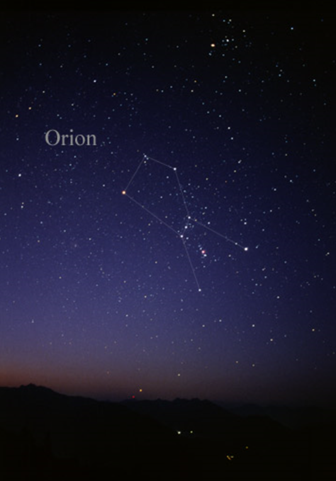
Figure 4b

Figures 4a, b. The constellation of Orion, as viewed from the Earth (Fig. 4a) and the graphical depiction of the ancient warrior (Fig. 4b; both from Wikipedia).
1Gleick, J. 1987; Chaos, Making a New Science; Penguin Books, 354pp
2Wikipedia: Pleiades
3Wikipedia: Orion