
What do the speed of light, diminishing luminosity, Cepheid variable stars, and the redshift all have in common? First, they were each briefly summarized in the previous blog (Part 3a); and second, they were critical tools in Edwin Hubble’s cosmological tool chest. Hubble’s genius lay not only in his amazing observational skills, but also in an analytical mind that allowed him to integrate previous findings into his own research. His discoveries established foundational cornerstones that support our understanding of God’s handiwork through astronomy. Part 3b will examine how these discoveries also extend the appearance of great age to the distant reaches of the universe.
* * *
The Mt. Wilson Observatory (Figure 1) was a monumental, 13-year construction effort (1904-1917) that overcame a 4850-foot elevation change between Pasadena (CA) and the construction site on top of Mount Wilson. It houses the Hooker telescope, with a giant, 100-inch mirror that was the world’s largest at the time. It and the other large, observatory components were hauled up the crude, 18-mile Mt. Wilson Toll Road by an early version of the Mack Truck (Figure 2). 1 Such a powerful telescope and advanced research facility required a brilliant and tireless mind. Enter Edwin Hubble.
[NOTE: This blog references the amazing Hubble Space Telescope (HST). For over 20 years, the HST images have greatly advanced our view and understanding of the universe. Part 3b was written almost a year in advance of the launch and successful deployment of the James Webb Space Telescope (JWST). The initial JWST imagery confirm that it is, indeed, many times more powerful than even the HST. The JWST imagery will be incorporated when available and discussed in future blogs.]
Edwin Hubble and His Contributions to Astronomy
Hubble completed his Ph.D. in astronomy in 1917 and promptly entered the U.S. Army during World War 1 (although he never saw combat)2. He returned and completed a year of advanced study in astronomy at Cambridge during 1919. He was offered a staff position at the Hooker Telescope that same year and remained on staff until his death in 1953.
Prevailing View of the Cosmos (~1920). The universe was thought to be infinite in size and age at the time of Hubble’s arrival at the Hooker Telescope. Multitudes of stars were visible with the larger telescopes and were assumed to extend throughout the universe. Other mysterious features termed “nebulae” (Figure 3) were believed to be spiral clouds of dust and gas.
The infinite nature of the universe appealed to many scientists at the time, including many of Hubble’s colleagues. The chance that life emerged naturally (without a Divine Creator) was recognized as exceedingly difficult by scientists, even at that early date. Many assumed that infinite amounts of time would be required to trigger life and initiate an evolutionary process.
Hubble’s Early Observations and Initial Discovery. Hubble focused upon the largest nearby spiral nebulae as his initial research task. Earlier work by other astronomers during the 1800’s and early 1900’s had identified internal structure within the nebulae; it also included a “stellar” (star-related) spectrophotometric signature. However, even with these data, the object was still thought to be a gaseous and dusty spiral nebulae within our own stellar neighborhood3. In 1924, Hubble aimed Hooker’s powerful mirror and lenses to the northeast sky and focused on the nebulae, termed “Andromeda” (see Figure 3).
The telescope’s enormous light-gathering capacity and magnification allowed Hubble to peer deeper into the object’s structure with greater resolution than any astronomer before him. For the first time, individual points of light—stars within Andromeda—became visible. And then he made his truly ground-breaking discovery. He identified a few stars that “pulsed” on a regular period—Cepheid Variables as described earlier by Henrietta Leavitt (see Part 3a of this section). After measuring their period lengths, he calculated their absolute luminosity. And, with the diminishing luminosity relationship (see Part 3a), Hubble determined that Andromeda was actually a vast collection of stars approximately 2.2 million light years from earth. The larger, scattered stars around the object were only a few thousand light years from earth.
Finally, Hubble tied it all together. Andromeda was a separate collection of stars, unassociated with the nearby stars in our own stellar neighborhood. Our neighborhood stars form a tiny part of another huge stellar collection termed the “Milky Way Galaxy.” The Andromeda and Milky Way galaxies are separated by 2.2 million light years of relatively empty “space.” Astronomers were simply “looking through” the nearby stars in our own galaxy and across vast distances of space to view Andromeda. Many other “nebulae” were quickly confirmed as galaxies at astonishing distances from earth.
Hubble’s findings and interpretation changed the fundamental scientific view of our universe.2 Although many of his more renowned peers scoffed at the results, Hubble published his findings and was awarded a $500 gift by the American Association Prize organization. His interpretation and galaxy classification system became a cornerstone of modern-day astronomy.
Hubble’s Second Discovery and Its Significance. Edwin Hubble didn’t stop. He began studying 46 other galaxies such as Triangulum (3.2 million light years distance) and their distances to earth. In 1929, Hubble identified a relationship between their distances by calculating their “radial velocities,” or, how fast the galaxies were moving away from earth. After combining his distances with measurements of the redshifts of the galaxies (from Vesto Slipher; see Part 1), he found a roughly linear relationship between the distances of the galaxies and their radial velocities, a discovery that later became known as Hubble’s Law.
So, why spend such time and text describing Edwin Hubble’s achievements?
Hubble’s discovery of the distance—red shift relationship opened the door for measurements to the most distant objects we can view in the universe. Greater redshifts reflect greater distances to the object. And, given the redshifts that we observe today with the Hubble telescope, we know that some galaxies reside at least 10-12 billion light-years from earth. Hence, their light has travelled 10-12 billion years to reach our planet. Astronomy now suggests the universe is at least 14-15 billion years old.
Comparison of Distance/Age Measurement Methods (Galaxy M-100)
Distance/age measurement methods, like all analytical methods, should be reproduceable and accurate. It would be irresponsible if I failed to share at least one example of their consistency. Follow me now to a distant galaxy—far, far, away—and prepare to be shocked by the power of the Hubble Space Telescope (HST) that circles our earth, and the consistency between two diverse distance measurements.
* * *
If you happen to be in a desert in the western U.S. states on a summer night with clear skies, look toward the northeast and find the Virgo constellation. If you have a pair of binoculars, look within Virgo’s “arms” and notice the small, fuzzy “stars” amidst the brighter, sharper stars of our own galaxy. The fuzzy stars are part of the giant Virgo supercluster of galaxies that reside within the Virgo constellation (we’ll identify its location and discuss the cluster in our next blog). Many of the galaxies have been studied in detail and galaxy M-100 is quite well known.
M-100 is a beautiful, spiral galaxy that lies almost perfectly perpendicular to our solar system. Figure 4 shows an image from the ESO La Silla Observatory in Chile. However, the HST orbits earth at an altitude of 340 miles, unhindered by atmospheric aberrations, and is phenomenally powerful.4 Figure 5 shows another image of M-100 through the lens of Hubble. The resolution is truly astounding, but the HST can do much more.
In May, 1994, the HST identified 20 individual Cepheid Variable stars within M-100 (Figures 6a, b).5,6 The distance from Earth was calculated as 56 million light years using Henrietta Leavitt’s absolute brightness relationship (see Part 3a) and the diminishing luminosity equation. This is nearly identical to the redshift-calculated distance of 55 million light years. Many other examples demonstrate the consistency between these two measurement methods, and some even include a third method which calculates distances using the parallex angle and trigonometry (not discussed).
Summary and Conclusions
This concludes our discussion on the topic of “Time.” Hopefully, at this point, you grasp the roots of the controversy between those who strictly promote the Young Earth view and others who promote great age in the universe. Lord willing, we’ll address this controversy with at least two effective creation models in future lessons.
And finally, I hope these lessons have provided you a better insight of our planet and the heavens surrounding us. We are now equipped to explore how an “understanding” of His creation points scientists to God, as per Romans 1:18-23. God’s fingerprints are unmistakable and gently lead those scientists with open minds to recognize His existence. Many do—it was the scientists who coined the term of our next topic, “Intelligent Design.”
1Wikipedia; Mount Wilson Observatory; https://en.wikipedia.org/wiki/Mount_Wilson_Observatory
2Wikipedia: Edwin Hubble; https://en.wikipedia.org/wiki/Edwin_Hubble
3Wikipedia: Andromeda Galaxy; https://en.wikipedia.org/wiki/Andromeda_Galaxy
4 Wikipedia; Hubble Telescope; https://en.wikipedia.org/wiki/Hubble_Space_Telescope
5NASA, Hubble’s Messier Catalog; Messier 100 (October 9, 2017); https://www.nasa.gov/feature/goddard/2017/messier-100
6NASA HubbleSite (October 16, 1994); Hubble Snapshots Capture Pulsation Rate of a “Stellar Milepost.” https://hubblesite.org/contents/media/images/1994/49/225-Image.html?news=true
Figure 1a, b. Mount Wilson Hooker Telescope Enclosure (Fig. 1a), and Telescope (Figure 1b).
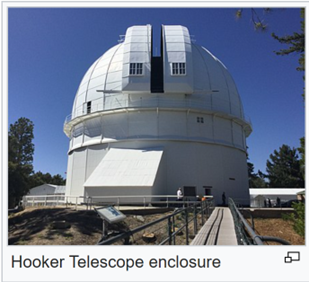
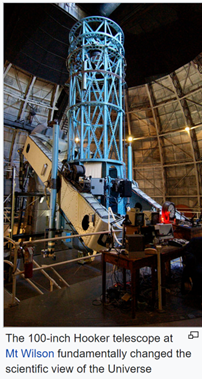
Figure 2. Early Mack Truck hauling the 100-in Hooker Telescope mirror to the Observatory.
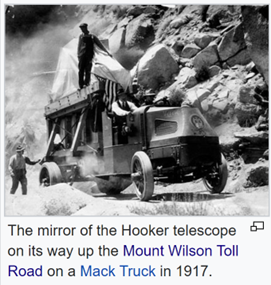
Figure 3. Nearby “spiral nebulae” later identified as the Andromeda Galaxy.
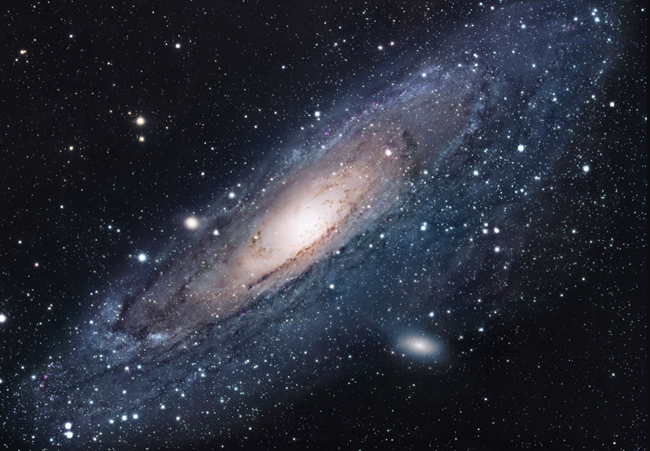
Figure 4. Good Earth-based image of the M-100 galaxy. This image is based on data acquired with the 1.5 m Danish telescope at the ESO La Silla Observatory in Chile. Credit: ESO/IDA/Danish 1.5 m/R. Gendler, J.-E. Ovaldsen, C. C. Thöne and C. Féron
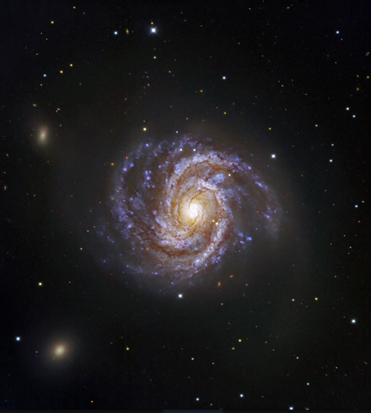
Figure 5. Image of M-100 spiral galaxy acquired by the Hubble Space Telescope.
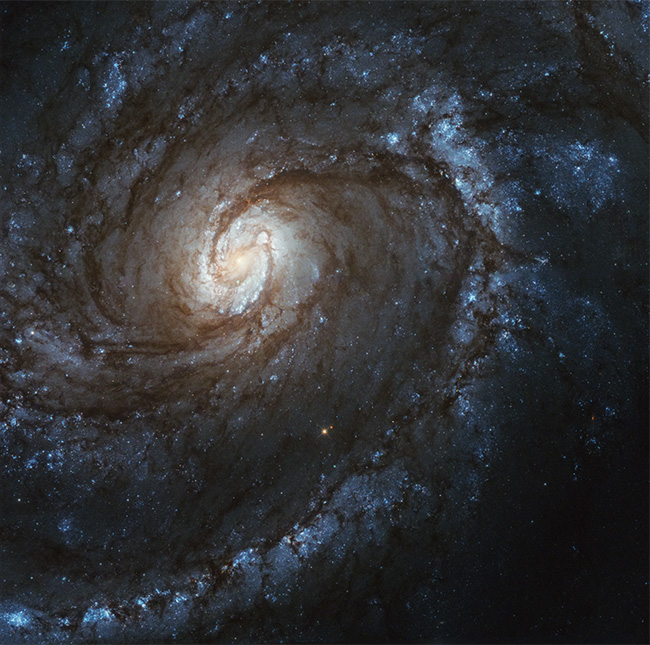
Credits: NASA, ESA and Judy Schmidt
Figure 6a, b. Cepheid variable star in M-100 as observed through the Hubble Space Telescope. The first image shows the star and its location within M-100. The second image (Figure 6b) shows the star’s brightness pulsation (pulsation rate = 51.3 days; 56 MM light years).
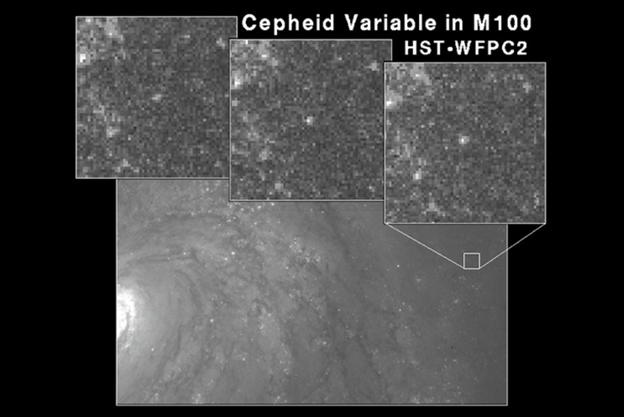
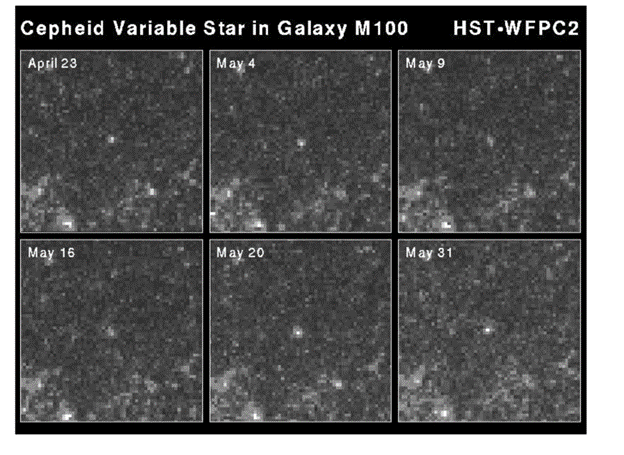
Credits: Wendy L. Freedman, Observatories of the Carnegie Institution of Washington and NASA