Welcome back!
Days 1-4 of the Old Earth Creation Model discussion are available in Blogs #35 and 36. Day 5 is about to begin. And although we’ve covered only four of the six creations days (67% of God’s creation week), we’ve addressed 95% of the creation’s age according to geologic time. The unequal lengths of each creation day and the great length of Day 1 source the discrepancy.
This blog’s discussion of Days 5 and 6 will be brief. We recently addressed the Cambrian Explosion in the Evolution section, specifically in Blog #32, and that’s precisely where we begin with Day 5.
* * *
The intent in this Creation Models section is to integrate Old Testament creation-related verbs with the relevant Scriptural cross-references. These verses, when further integrated with current scientific observations and dates, segregate the Young and Old Earth models. The Young Earth model focuses upon a strict, literal interpretation of Genesis 1 with minimal integration of current scientific observations.
As noted in Blogs #34-36, the model comparisons will follow the basic ground-rules and interpretive formats listed below:
- Use All Available Scripture
- Assume Scientific Age Measurements are Legitimate (Romans 1)
- Acknowledge That God’s Natural Laws Control the Earth (and Universe; Job 38)
- Acknowledge That God Also Works Via Occasional Miraculous Intervention
Scriptural interpretation will include the important, ancient Hebrew verb definitions:
- “bara” – “The root bara has the basic meaning ‘to create’ . . . bara emphasizes the initiation of the object—from out of nothing.” I used the phrase, “God spoke, and “poof!” it happened.”
- “asa” – “When used in the sense of ‘to make’, the emphasis is on the fashioning of the object” . . . implication is to do, or make from previously existing material.”
- “yatsar” – “When used in the sense of ‘to make’, the emphasis is on the fashioning of the object” . . . implication is to sculpture, or form like pottery.”
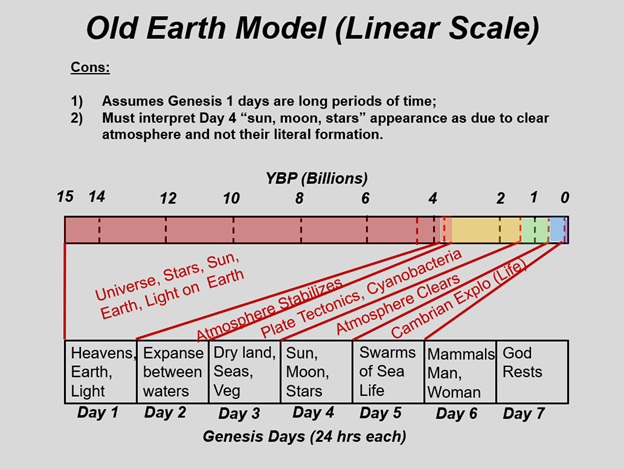
Comparisons will also be made between the seven “days” in Genesis 1 and the estimated age of the universe (15 By) using a time comparison chart (referenced below).
Thousands of technical papers address and describe solar and planetary formation mechanisms and post-formation processes on Earth. I referenced two books when discussing Days 2-6 that summarize these mechanisms1,2 and follow Paul’s encouragement in Romans 1:18-20 to “understand” God’s creation and integrate the technical (scientific) data and observations. The Old Earth model considers science and scientists as allies for data acquisition and recognizes that scientists themselves can be converted to God as they seek to “understand” the data.
Finally, I described an amazing event in Blog #32 that initiated the creation events of Day 5 in Genesis 1 – the Cambrian Explosion. It is only the second time throughout the entire creation process that God’s actions were described with the “bara” verb. I’ll review and further elaborate on the event in the “Day 5” section, below.
The Daily Ledger
This section summarizes the previous critiques (Blogs #34-36) of the Old Earth model’s interpretation of Genesis 1 on a day-by-day basis. (See also Blogs #21-24 – “The Creation Event” series, for additional context.) And again, the following summary reflects my experience with Old Earth teachings and may vary from other Old Earth views.
Day 1. Day 1 of the Old Earth model was discussed in Blog #35 and will not be repeated here, except to note that the collision between Earth and Theia (the planetoid) radically changed our early planet.
Days 2-4. The collision with Theia altered Earth’s surface and early atmosphere and initiated the progression of Days 2-4 (see Blogs 36 and 37). Atmospheric stabilization occurred during Day 2, and our familiar hydrologic cycle of evaporation, condensation, rainfall, and transport likely began during this period.
Day 3. This Day began with God’s command to “let the dry land appear,” implying a change in surface physiography. Uplift occurred in one of more areas while the remaining ocean crust remained stable as ocean basins. We see crustal modification at work today in the process called “plate tectonics.”
Once dry land “appeared,” God shifted His Day 3 creation activities to biology. Day 3 concluded with God’s command to “bring forth” vegetation. Scripture offers little insight on the mechanism or direct involvement by God. The diversity of the earliest plant species is also unknown. Perhaps it simply included the introduction of cyanobacteria, or “blue-green algae” as stromatolites.
Day 4. This is perhaps the most controversial of all the Genesis 1 creation days. If the “appearance of the sun, moon, and stars” on Day 4 references their literal creation, it clearly conflicts with the Old Earth sequence that posits the astronomical bodies were created on Day 1. However, the conflict is resolved if, as the Old Earth model suggests, our atmosphere cleared during Day 4, and the sun and moon first became visible from Earth’s surface—our frame of reference—through the transparent atmosphere.
The precise start and completion times for Days 2-4 are speculative. Figure 1 shows their estimated position on the time scale comparison chart.
Day 5 (Genesis 1:20-23). As a quick recap, notice above that Day 3 began with the global change in Earth’s surface physiography—dry land appeared. Notice also that God’s actions immediately switched from physical to biological with the introduction of plant communities via the verb “asah.” Final clearing of the atmosphere on Day 4 provided a clear view of the sun and moon as suggested in Blog #36; it provided direct sunlight to Earth’s surface and the onset of full-scale photosynthesis.
The first multi-cellular organisms identified in the fossil record occurred during the Vendian period. The most abundant assemblage of Vendian organisms occurs within the Ediacaran sub-group (about 600-540 Mya). They were relatively simple organisms with no circulatory system, brain, or other organs that are found in advanced lifeforms. Most of the Vendian lifeforms simply disappeared during a major extinction event (around 538 Bya; see Parts 7 and 8 of the Evolution Series; Blogs #31 and 32).
Finally, on Day 5, in a period possibly as brief as 400,000 years, an explosion of life occurred in seas and oceans around the world as at least 30 phyla of advanced organisms sprang into life (around 538 Mya; see Parts 7 and 8 of the Evolution Series; Blogs #31 and 32). The Cambrian Explosion provides one of the most challenging difficulties faced by evolutionary biologists. The event itself is amazing; however, it’s stunning when linked with Scripture (Genesis 1:20-23). The “bara” verb implies that God spoke, and the oceans immediately teamed with new critters. It beautifully summarizes the appearance of marine fossils observed in Early Cambrian sediment.
Several major and minor extinction events occurred during the next 480 My, each followed by bursts of new animal groups that followed the general progression (see Blog #32):
Arthropods → Fish → Amphibians → Reptiles
This cyclical, global process of mass extinctions and explosive waves of new organisms also seems to beautifully fit an Old Testament scripture we’ve considered before (see Blog #33):
Psalm 104: 24-30
O Lord how many are Your works! In wisdom You have made them all. The earth is full of Your possessions. There is the sea, great and broad, in which are swarms without number, animals both small and great…. They all wait for You to give them their food in due season. You give to them, they gather it up; You open Your hand, they are satisfied with good.
You hide Your face, they are dismayed; You take away their spirit, they expire and return to their dust. You send forth Your Spirit, they are created; and You renew the face of the ground.
I’ve wondered what the Psalmist who received this Word from the Lord must have thought when he penned the words and pondered their meaning. I’m confident that he did not relate it to the cyclicity of ancient life as exposed in the fossil record. But what other meaning could it imply?
Day 5 apparently ended with another mass extinction, based upon the fossil record and Scripture’s description of Day 6 (Gen. 1: 24-31). Most of the dinosaurs and all the large, carnivorous species vanished at approximately 63 Mya, triggered by the giant Chixchulub asteroid impact on Mexico’s Yucatan peninsula. Figure 1 plots the duration of Days 5 (and 6) on the time-scale comparison chart. Unlike most of God’s “Days” in Genesis 1, we know their start- and end-dates precisely.
Day 6 (Genesis 1:24-31). The extinction of most reptilian life-forms by the asteroid impact apparently cleared the way for God’s global introduction of mammals. Although several primitive mammal-like animals have been identified in Jurassic and Cretaceous sediment that pre-date the impact, the abundance and diversity of mammals exploded shortly thereafter. The Bible’s description of God’s creative work (Gen. 1:24, 25) emphasizes the “asah” verb – once again suggesting their appearance from previously existing material.
Finally, as the crown of His creation, Genesis 1:27 states that God “created man in His image,” via the verb “bara.” This is the third and final time that “bara” was used in the Genesis 1 creation account. Genesis 2:7 further explains that God gathered “dust of the earth” and made and sculpted man via the verbs “asah” and “yatsar.” He then “breathed into Adam’s nostrils the breath of life.” God employed each of the three verbs in His creation of mankind.
Critique
Days 2-4 are characterized by massive changes in the Earth’s atmosphere and surface. Not only did the continents develop during these periods, but vegetation “sprang forth” as well. There is also difficulty in assigning specific age estimates for the duration of each “day” and their estimated starts and endings.
If the sun, moon, and stars formed on Day 4, it would absolutely conflict with the Old Earth model. If it refers to the complete clearing of the atmosphere, the Old Earth model explains it beautifully. The general sequence of creation events in Days 2-4 follow the exact order as observed in His creation.
God’s focuses on the progression of life during Days 5 and 6. The sequence concludes with the introduction of mammals in early Day 6, and lastly, the pinnacle of His creation – mankind, through Adam and Eve. My perspective of the “Pros and Cons” of the Old Earth Model’s account for Days 5 and 6 are included below:
| PROS | CONS |
| Rigorously integrates other Old and New Testament Creation verses to form a greatly expanded Old Earth model. | Completely abandons any association with the “24-hour” reference in Genesis 1 (a “Con” to some). |
| Rigorously integrates the specific Creation verbs and their meanings with the Model context. | The proposed length of Day 1 (8+ billion years) is unacceptable and repulsive to those with a Young Earth persuasion |
| Follows Romans 1:18-21 and Psalm 19:1,2 to “understand God’s creation” and thus gain a greater knowledge of Him. | |
| The Old Earth model (Day 1) provides a striking similarity to the conditions on Earth during that time, as recorded by scientific observations. | |
| Atmospheric clearing and stabilization on Day 2 fits exactly with the planetary models | |
| The initiation of plate tectonics to form continental land masses likely began at an early date in Earth history. The sequence in Genesis on Day 3 makes sense. Land vegetation began early in Day 3 if the vegetation included stromatolites | The formation of seed and fruit-bearing vegetation appears to have occurred much later in the fossil record. A very long Day 3 would be required to account for these vegetation types. |
| This model assumes Day 4 is the period in which the atmosphere cleared, and the sun, moon and stars became visible from Earth | If the sun, moon, and stars were truly created on Day 4, the Old Earth model is rejected. |
| The 2nd use of the verb “bara” to describe God’s creation of “all the sea creatures” on Day 5 (Gen. 1:20-23) beautifully describes the amazing, and essentially instantaneous appearance of sea-life in the fossil record, termed the “Cambrian Explosion.” | |
| Again, the cyclical sequence of mass extinctions, followed by explosive appearances of new creatures as displayed in the fossil record seems to be beautifully described by Ps. 104:24-30. | |
| God’s creation sequence of mammals on Day 6, and then man, His final act of creation, precisely follows the observed fossil record sequence. |
My hope, at this point, is that you have a new appreciation of the technical legitimacy of the Old Earth model, even if you question, doubt, or deny the great age of the earth and universe that it portrays.
Also at this point, we are finally prepared to tackle this issue of “time” and the apparently huge discordance between the Old Earth and Young Earth models. The Time Dilation model provides a beautiful integration of the Young and Old Earth models, as difficult as it may sound. The Time Dilation model discussion, and our journey to this point have been a “long-time coming;” hopefully, the model will astound you as it has me.
1Ross, H. (2014) Navigating Genesis, A Scientist’s Journey through Genesis 1-11. Reasons to Believe (RTB) Press; 298 pp.
2Ross, H. (2022) Designed to the Core. Reasons to Believe (RTB) Press; 290 pp.
Figure 1. Position of Days 1-6 on the time scale chart in relation to the traditional Young Earth scale.