
This blog provides an overview of Day 1 of the Old Earth model. The task is daunting—its intent is to provide a simple summary of the natural history of the universe as seen through the eyes of science, and yet integrated with the Bible. It’s the second of six creation models listed in our previous blog (Blog #34) which addressed the Young Earth model. The list of models is provided below once again:
- Young Earth Model
- Old Earth Model
- Time Dilation Model
- The Gap Theory Model
- Apparent Age Model
- Naturalistic Model
Our previous blog emphasized the necessity to focus on the Old Testament cross-references and creation-related verbs. Scripture, when truly integrated with current scientific observations and dates, deeply divides the Young and Old Earth models. (The Young Earth model primarily focuses upon a strict, literal interpretation of Genesis 1.)
The model comparisons will follow the basic ground-rules and interpretive formats listed below:
- Use All Available Scripture
- Assume Scientific Age Measurements are Legitimate (Romans 1)
- Acknowledge That God’s Natural Laws Control the Earth (and Universe; Job 38)
- Acknowledge That God Also Works Via Occasional Miraculous Intervention
Scriptural interpretation will include the important, ancient Hebrew verb definitions:
- “bara” – “The root bara has the basic meaning ‘to create’ . . . bara emphasizes the initiation of the object—from out of nothing.” I use the phrase, “God spoke, and “poof!” it happened.”
- “asa” – “When used in the sense of ‘to make’, the emphasis is on the fashioning of the object” . . . implication is to do or make from previously existing material.”
- “yatsar” – “When used in the sense of ‘to make’, the emphasis is on the fashioning of the object” . . . implication is to sculpture, or form like pottery.”
Time comparisons will also be made between the seven “days” in Genesis 1 and the estimated age of the universe (15 By) using the comparison chart shown in Figure 1.
Finally, the six creations models considered in this series are displayed in Figure 2. The first five models on the chart assume some aspects of “old age” within the universe, whereas the sixth is the “Young Earth” model. The Old Earth discussion views Creation from a very different perspective than the latter!
Old Earth Model
The Old Earth model incorporates both scripture and scientific observations. Thousands of technical papers describe and explain the solar and planetary formation mechanisms discussed below. I will lean upon two books that summarize these mechanisms.1,2
This is NOT the creation model that established and traditional Christian believers have seen presented and defended. The model rigorously employs the ancient Hebrew creation verbs and many scriptures outside of Genesis (such as Isaiah 45:18). It follows Paul’s encouragement in Romans 1:18-20 to “understand” God’s creation and thus integrates the technical (scientific) data and observations. It considers science and scientists as allies in data acquisition and recognizes that scientists themselves can be converted to God as they seek to “understand” the data.
A controversial aspect of the Old Earth model includes the progressive translation of the Hebrew word “yom” and the accompanying terms for “sunrise” and “sunset” as a “period of time with a specific beginning and ending.” Hence, the Young Earth interpretation of “yom” as a 24-hour period is refuted by the Old Earth view that each “day” in Genesis 1 reflects long, and perhaps vast periods of time. I’ll make extensive use of the time comparison chart (Figure 1) to illustrate these differences.
And, as in the previous blog, the strategy with each model discussion will include a review and/or interpretation of each creation day. From the review I’ll develop a list of “Pros” and “Cons” for each model, as I understand them.
The Daily Ledger
This section critiques the Old Earth model’s interpretation of Genesis 1 on a day-by-day basis. (See also Blogs #21-24, The Creation Event series for additional context.) And again, the following summary reflects my experience with the Old Earth teachings, which may vary from yours or other Old Earth views. Day 1 in the Old Earth model is vast in age; this blog will focus upon it alone.
Day 1 (Early). God’s first action was to “create (bara) the heavens and the earth.” I shared in the previous blog that the “heavens and earth” are viewed as two, independent entities in the Young Earth model, both simply “spoken” (“bara-ed”) into existence by God. However, this interpretation conflicts with Isaiah 45:18, which specifically states that God created (bara) only the heavens, but later made (“asa” – from previously existing material) and formed (“yatsar” – “sculpted”) the earth to be inhabited. The verse and verb forms are provided below:
Isaiah 45:18
For thus says the Lord, who created (bara) the heavens (He is God who formed [yatsar – sculpted] the earth and made (asa) it, He established it and did not create (barah) it a waste place, but formed (yatsar) it to be inhabited), I am the Lord, and there is none else.
So, can we reconcile Genesis 1:1 with Isaiah 45:18?
Yes! The phrase “heavens and earth” (Genesis 1:1) is used over 500 times throughout the Old Testament to represent the “totality of God’s creation.” Our English word is “the universe,” and all it contains. So, with this interpretation, Genesis 1:1 states that God created (“bara”) the totality of the universe and later formed the earth from pre-existing material. It resolves the apparent conflict with Isaiah 45:18.
So, how did it all begin?
Blogs #12-17 addressed “Time” from several different perspectives. It was shown to be a physical entity interlocked with distance (space), mass, and energy as per Einstein’s equation “E=mC2” where “C” is the speed of light, or “distance/time.” The equation can be re-written to show that “Time” is defined by the expression “time = distance * √(E/m).
The Bible also reveals that time had a beginning—God existed before time (Jude 1:25). So, if time had a beginning, then so did energy, mass, and distance.
The Old Earth Model proposes that when God created (“bara”) the universe in Genesis 1:1, these four entities came into existence at a single point. Space rapidly expanded while the unfathomably hot temperature declined proportionally. This process follows what scientists refer to as the “Big Bang” model. As space expanded, mass and energy dispersed while the temperature continually dropped. Eventually, the temperature cooled to the point that atoms (primarily hydrogen and some helium) could form. Within one billion years, the clouds of hydrogen/helium had collapsed through gravitation into the earliest, hydrogen-rich stars and galaxies. These early “protogalaxies” are viewed today through the Hubble and James Webb space telescopes as small, extremely distant, red-shifted objects (Figure 3).
As those of you familiar with astronomy will recognize, Day 1 via the Old Earth model is exceedingly long. Figure 4 shows the Early Day 1 comparison between the Old and Young Earth models.
Day 1 (Mid-Day). Universal expansion (the stretching of space itself), cooling, and aging eventually led to the burnout and supernovae of the 1st generation stars.1,2 They ejected heavier silicate and metallic dust and other debris. Second generation stars were birthed though gravitational collapse of the ejected dust (Figure 5). The stars progressed through their life cycle, and their 2nd-generation supernovas also released dust, but with much higher metal levels. The birth of 3rd-generation stars from 2nd-generation dust had sufficient metal content to form planets. And the stage was finally set for our sun and solar system. Figure 6 shows the comparison time scales between the Young Earth and Old Earth models at mid-Day 1.
Day 1 (Late). The Old Earth model places the birth of our sun, a 3rd-generation star, at about six-billion years ago. Gravitational collapse of the local dust formed a rotating disc, termed a “proplyd” (Figure 7). Proplyds are observed in many star-forming regions of our galaxy, such as the Orion Nebulae. Gravitational collapse of the dust within our proplyd continued until its core ignited in fusion—and our sun was born.1,2
Planetoids also began to develop through gravitational accretion of the residual dust and debris. Eventually, Earth and the other inner planets formed. The accretionary process on Earth is referred to as the “Hadean” period (see Blogs 21-24 for further details). Astronomical planetary formation models suggest the early Earth would have been spinning rapidly with surface winds likely exceeding 1000 mph. Suspended dust and rocky debris would have made our atmosphere opaque, and perhaps laden at an early date with suspended water or water vapor.1,2 Think of it as the interior of a high-speed kitchen blender in a dark room. Our planet’s surface would have also been inhospitable. Now, read God’s description of early Earth through Genesis Chapter 1 and the writings of Job:
Gen. 1:2
The earth was formless and void and darkness was over the surface of the deep (the oceans)
Job 38:8-9
Who shut up the sea behind doors when it burst forth from the womb, when I made the clouds its garment and wrapped it in thick darkness?
Sounds like the scientific model, correct? But, as we saw above in Isaiah, God was not content to leave the Earth a “waste place,” rather, He made it (asa, from previously existing material) and sculpted it (yatsar; as a potter) to be inhabited.
So, what changed? How did God sculpt this tiny spinning globe of amalgamated rocky debris with an opaque atmosphere and no iron core into “a place to be inhabited?” And remember from Blog #21, Job 38:33 states that God controls the Earth through His heavenly (universal) laws; it’s not unreasonable to assume those same laws controlled its formation.
Once again, scientific observations when coupled with Scripture provide important clues.
Between 1969 and 1972 the U.S. successfully completed six Apollo missions to the moon. Combined, the missions returned to Earth with 842 pounds of rocks, dust, cores, etc. Exhausting studies of the specimens have revealed much about the early history of the moon. Exotic metal and oxygen isotope ratios were measured. These ratios vary widely between meteorites and between the younger and more weathered rocks on Earth. Surprisingly, the moon rock ratios were practically identical to the older, crustal rocks on Earth.3 Furthermore, the range of moon rock ages was essentially identical to the earliest crustal rocks on Earth. The data suggest that the moon was derived from Earth’s early crustal rocks. The very slight differences between the moon and Earth ratios were explained when a third source (with mildly different ratios) was integrated with the Earth-moon signature.
Scientists hypothesize that the third source was an iron/nickel, Mars-sized planetoid (termed “Theia”) that struck Earth during its accretion event (Figure 8). The speed, angle of descent, size, etc. had to be perfect (i.e. designed by God) for Earth to survive the hit. The collision blew off sections of Earth’s upper mantle and crust. The sediment encircled the planet and eventually accreted into the Moon. Most of Theia was absorbed into the Earth’s interior, eventually forming our large Fe-Ni core. The collision would have blown away a portion of the opaque atmosphere, allowing translucent light to finally reach our young planet’s surface.
Now, let’s review the remaining passages in Genesis 1:1-5 and another verse from Isaiah:
Genesis 1:2-5:The earth was formless and void, and darkness was over the surface of the deep, and the Spirit of God was moving over the surface of the waters. Then God said, “Let there be light”; and there was light. God saw that the light was good; and God separated the light from the darkness. God called the light day, and the darkness He called night. And there was evening and there was morning, one day.
Isaiah 42:5
Thus says God the Lord, who created (bara) the heavens and stretched them out who spread out (raqa- to hammer out; JRC) the earth and its offspring…
“Formless, void, darkness, wrapped in clouds (Job 38:8-9), a “hammering out” of the Earth AND its offspring (Isaiah 42:5), and the first appearance of light.” These descriptions of early Earth fit amazingly well with the planetary accretion model. Plus, a different term was used in Isaiah 42:5 to describe another of God’s actions during the accretionary process – He “hammered it out.” What an appropriate phase! And, what else could be Earth’s “hammered out” offspring except the moon?
Finally, the Spirit hovered/moved over the surface of the water (Genesis 1:2) in Day 1. We discussed in Blog #30 that the earliest indication of life on Earth were tiny blebs of organic carbon (graphite) that possess a Carbon 13 isotope ratio found only in living organisms. The blebs were encased in metamorphosed rocks of 4.1 Gya (billion years in age). We also noted from Psalms 104:28-30 in Blog #33 that the Spirit was associated with the initiation of life. Life appears to have sprung into existence almost immediately after the accretionary process ended.
Figure 9 shows the timescale chart comparison between the Young Earth and Old Earth models for Day 1. The Old Earth model suggests that Day 1 covered about 60-70% of the age of the universe!! Again, this may seem preposterous, but press-on!
Critique
This massively long “day” is a huge challenge for the Young Earth supporters to believe or accept. However, the Old Earth Day 1 model integrates Genesis 1:1-5 with many other Old Testament verses and compiles a much more comprehensive scriptural model of God’s early work in Creation than could ever be obtained simply through Genesis 1. In doing so, it also establishes an amazing bridge with scientific observations that point to an expanding universe, three generations of stars, and the formation of a proplyd that eventually birthed our sun and the planet we call Earth.
Finally, listed below are my perspectives of the Pros and Cons of the Old Earth model:
Finally, listed below are the Pros and Cons of the Young Earth model from my perspective:
| PROS | CONS |
| Rigorously integrates other Old and New Testament Creation verses to form a greatly expanded Old Earth model. | Completely abandons any association with the “24-hour” reference in Genesis 1 (a “Con” to some). |
| Rigorously integrates the specific Creation verbs and their meanings with the Model context. | The proposed length of Day 1 (8+ billion years) is unacceptable and repulsive to those with a Young Earth persuasion |
| Follows Romans 1:18-21 and Psalm 19:1,2 to “understand God’s creation” and thus gain a more complete knowledge of Him. | |
| The Old Earth model (Day 1) provides a striking similarity to the conditions on Earth during that time, as recorded by science. |
The next blog will hopefully cover the remaining Old Earth model, Days 2-6. Our former blogs have already discussed many of the processes that were included in this more “recent” portion of God’s Creation!
1Ross, H. (2014) Navigating Genesis, A Scientist’s Journey through Genesis 1-11. Reasons to Believe (RTB) Press; 298 pp.
2Ross, H. (2022) Designed to the Core. Reasons to Believe (RTB) Press; 290 pp.
3Cano, E.J., Sharp, Z.D. & Shearer, C.K. Distinct oxygen isotope compositions of the Earth and Moon. Nat. Geosci. 13, 270–274 (2020). https://doi.org/10.1038/s41561-020-0550-0
Figure 1. Time-scale comparison chart between the seven days in Genesis 1 and the estimated age of the universe from scientific observations.
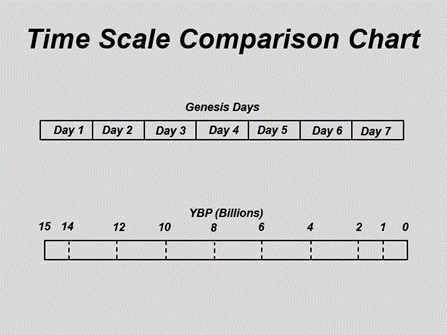
Figure 2. The six creation models discussed in this series.
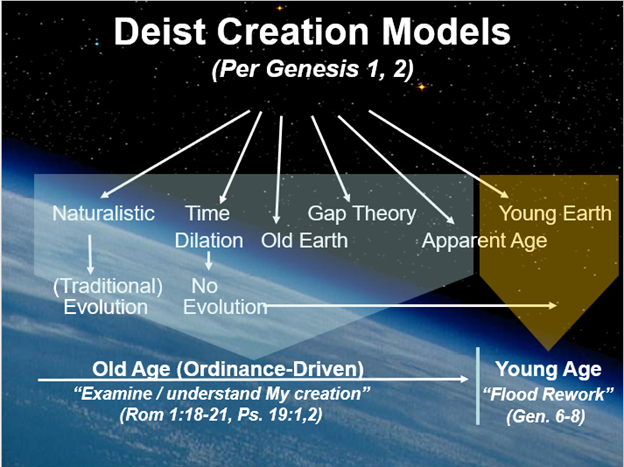
Figure 3. Hubble Deep-Field image showing extremely red-shifted distant objects believed to be the original, early proto-galaxies with 1st-generation stars.

Figure 4. Time-scale chart for Early Day 1, Old Earth model. This period alone covers 3-4 billion years.

Figure 5. Pictorial summary of 1st, 2nd, and 3rd generation stars.

Figure 6. Time-scale chart for Mid-Day 1, Old Earth model’s period of 2nd generation stars
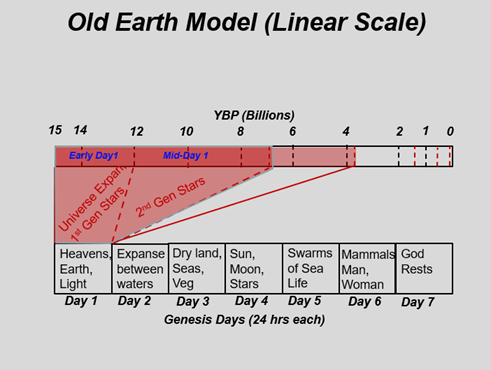
Figure 7. Proplyd formation and its on-going gravitational collapse. The proplyd core eventually ignites to form a sun and accrete the planets of a solar system.
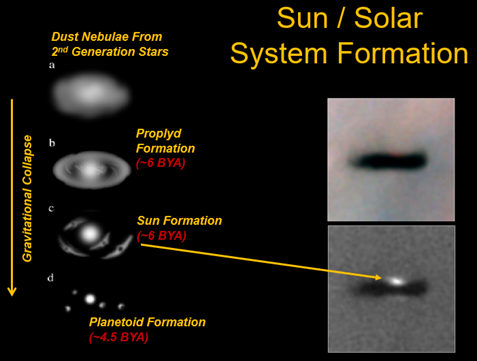
Figure 8. Planetoid “Theia” strikes the very young Earth. Moon forms from the debris.
Figure 9. Time-scale chart for Late Day 1, Old Earth model. Day 1 covers a period of 9-11 billion years.
