
In a previous blog, I asked two questions: 1) Are all scientists simply cold and unwavering atheists, duped by their own observations; and, 2) Does Scripture literally describe a very recent earth that God simply spoke into existence? These questions demand answers and provide the framework for our next two topics. This blog will address the former question via Parts 1 and 2.
Perhaps you believe that Question 1 accurately describes most scientists, and that “Science” simply reflects their beliefs and has no association with the Bible. You scoff at questions such as, “Are science and the Bible aligned?” In turn, this belief leads to conclusions that science (and scientists) cannot be trusted, and perhaps should be avoided or feared. But is this accurate?
I’m a scientist. Hopefully, by now I’ve won some level of your trust and perhaps even some recognition that I love and follow God’s Word. So, let’s consider the association between science and God’s Scripture. We’ll use the following agenda. Please consider which view aligns with your current belief.
Is it?
- Science versus the bible;
- Science or the bible; or,
- Science and the bible
Science versus the Bible
This is the dominant opinion within the Church—especially among many of those who actively teach on the topic of creation. Heated debates such as “Young Earth versus Old Earth” are birthed under this category, and few topics generate as much controversy as the following question:
“What happened to the dinosaurs?”
This question highlights the attitude of today’s Church toward science and our own internal disagreements on science-based topics such as the age of the earth and the “Global Impact of Noah’s Flood.” Notice the amazing contrasts in each group’s response:
WHAT HAPPENED TO THE DINOSAURS (ESPECIALLY THE LARGE THERAPODS AND CARNIVORES)?
Traditional (Young Earth) Church View
Scientific (And Old-Earth Church) View
When was the die-off?
Approximately 6000-8000 years ago
Approximately 60 million years ago
What was the catalyst?
Noah’s Flood and/or other scenarios
Meteorite impact on Yucatan Peninsula
How did they die-off?
Slaughtered by man prior to flood, or
Slaughtered by man following flood, or
Too large for ark, left behind, or
No dinosaurs – figment of scientist’s imagination, or
Still alive, undetected in rain-forests
Global environmental holocaust, and
Global “winter” for years, and
Complete ecosystem disruption, and
Habitat elimination; all due to asteroid
Evidence for die-off mechanisms?
Specific interpretations of Biblical Creation/Flood
accounts from a Young Earth viewpoint
Controversial interpretations of geological data; e.g.
– relocation of continents in a 100-day period
Massive impact crater on Yucatan Peninsula
World-wide distribution of thin layer of iridium-
Dinosaur fossils beneath (older than) clay layer,
mammal fossils above (younger)
A quick scan reveals how strongly the traditional (Young Earth) views differ from those in science and from many within the church who support an old earth view.
Notice that I lumped the “Old Earth” Christian responses with those of the scientists. The “Old Earth” camp believes that God created the earth and mankind, but that He worked in part through His natural laws and processes, unconstrained by time. They agree with Romans 1:21-23, that creation reflects His divine nature. And, finally, they believe that nature portrays a creation of great age—as most scientists believe; and hence, the grouping.
Traditional (Young Earth) Christians believe that scientists are mistaken in their interpretations of the natural data. Some believe that scientists have misrepresented the data and hold an old earth stance to support evolution. Consequently, many Young Earth Christians are skeptical or even adversarial toward science and scientists. And conversely, some scientists strongly ridicule the Church and many of the Young Earth teachings.
As discussed in my previous blog, and in this author’s opinion, this cannot be the way the Lord intended.
Science or the Bible
The preceding section painted an adversarial relationship between scientists and the Church—especially those Believers in the Young Earth camp. In this section we move from an adversarial viewpoint to one of ignorance—on both sides. I’ll start with science.
Scriptural Ignorance Among Scientists. As a scientist, I can speak of the ethics and views of my geologist and geochemist peers. “Scientists” can be divided into two major groups: 1) Those who work in various industries; and 2) those who participate in academic or industrial research positions.
Industrial scientists apply their expertise to solve specific technical problems. Like you and me, they are often overworked, stressed, and rushed to complete an endless schedule of tasks. They return home in the evenings—just like you and me—tired and worn, wondering what the next day will bring.
Academic and industrial research scientists are driven to understand why something works the way it does, but they are also captives of rigorously demanding schedules. They make observations (or do experiments), study the data, and are continually pressured to publish, especially those in academia who also teach, review tests, and consult students. Publications bring recognition, future students, and grants for further research, but it’s an arduous, peer-reviewed process.
I’ve worked as an industrial research scientist and I’ve also taught college classes. My point is this: Scientists do not arrive at work each morning pondering, “What can I do today to confound Christian theology with new scientific discoveries?” It’s a preposterous claim that is simply false. Instead, most scientists are absorbed by their studies of natural science and are generally ignorant of the Bible and its teachings. Their passion is scientific discovery.
There is no hidden, underlying pact by the general scientific community to advance evolution, to prove an “old earth,” or to disprove the existence of God. Sure, there are the outspoken few who advocate these positions, but we have our share of outspoken advocates in the Church, as well.
Scientific Ignorance Within the Church. Conversely, most Christians are ignorant of science. For decades, many Church teachers have proclaimed that science and scientists are out to disprove God. Let’s examine the validity of their claims, and begin with two definitions from Webster’s Dictionary:
Science: A system of knowledge regarding a specific topic; and
Truth: General facts about a subject
A simple combination of these definitions describes “scientific truth:”
A system of knowledge covering general facts
This definition sounds quite similar to Romans 1:18, 20:
For the wrath of God is revealed from heaven against [those-JRC addition] who suppress the truth. . . For since the creation of the world His invisible attributes. . . have been clearly seen, being understood [a system of knowledge-JRC addition] through what has been made [general facts-JRC addition].
It surely sounds as if Romans 1:18, 20 links our understanding of God’s invisible attributes to the scientific study of nature’s facts, at least according to Webster’s definitions.
Science is not evil.
So, why is there such skepticism and hostility in the Church toward science? Based upon comments I’ve received during my 15 years of teaching the Science and the Bible series, at least three common views/ misperceptions within the church fuel the conflict. These are considered below:
1. We don’t trust what we don’t understand.
Richard Zohner, in a 1997 high school science project, asked 50 adults if they would sign a petition to strictly control or ban the industrial chemical Dihydrogen Monoxide (DHMO). Several valid reasons were provided: a) the chemical is found within many cancerous tumors; b) its breakdown products are highly unstable and dangerously reactive; c) accidental inhalation can kill you. Of the 50 adults, 43 said, “Yes;” six were undecided; and, only one knew that DHMO is actually water. How do you ban water?
The survey illustrates that we are skeptical and naturally distrust what we don’t understand. But is that an honest approach? Legitimate scientific decisions require that we–Christians and scientists—investigate the data before we dismiss or “ban” an issue simply because we don’t understand it.
2. Science is often wrong.
The definition of “science” (above) refutes this view. Facts reflect truth; science and the facts are not “wrong.” However, our interpretation of the facts may, indeed, be flawed.
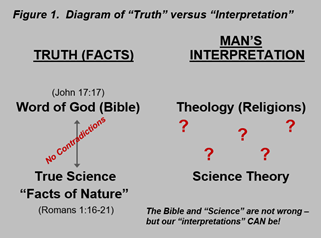
Figure 1 provides an example. God’s Word and His creation are both “truth” (discussed earlier; previous blog). However, our many church denominations reflect the diversity in mankind’s interpretations of various verses in the Bible. Different interpretations (theories) of natural, scientific facts also exist.
There should never be a contradiction between the Word and creation—each is pure truth. However, it’s easy to see how our Scriptural and scientific interpretations can and do conflict. Given our tendencies to distrust/dismiss what we don’t understand and given the Young Earth interpretations that disagree with a host of scientific interpretations, many Christians simply assume that “science is incorrect,” and the battle-line is drawn.
3. Science continually changes.
Scientific theories can, indeed, change following a new discovery or breakthrough. “Change” is a source of further skepticism in the Church. One might ask, “If science is really a ‘system of knowledge covering general facts (or truth),’ why would it change?” It’s a legitimate question.
Scientific interpretations are limited by the amount and quality of available data. A single chemical analysis may cost several thousand dollars. Tight research budgets greatly restrict the number of available samples for study. Consider this fictitious, but realistic example.
A pharmaceutical company learns of a powerful toxin that occurs in the skin of a small blue frog in the Brazilian Amazon rainforest. You are dispatched to collect a few specimens from a specific bend in the river that reportedly hosts the creature. Three specimens are captured. Back in the lab, samples of the toxin, one from each frog, are carefully extracted, analyzed, and tested as a bactericide. As demonstrated in Figure 2, it is an extremely effective toxin; however, there is a problem—the data trend appears reversed, suggesting that higher strengths of the toxin will kill fewer bacteria.
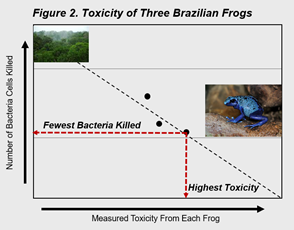
The results are encouraging, but confusing, and a second journey is made to collect additional frogs from a wider region. Upon return, the data are analyzed and plotted (Figure 3). The larger sample population reveals the truth—the toxin is a powerful bactericide and, as expected, kills more bacteria at greater strengths. The false trend in Figure 2 was simply noise in a small subset of the natural population.

This is a very real problem that has impacted my own studies of regional groundwater chemistry. You collect and assess your data, make a scientific interpretation, and later, with more samples, discover that your interpretation was incomplete. Other challenges also exist, such as unrecognized interferences that generate erroneous analytical data. This occurred in several, early, age-dating isotope studies during the 1960’s and 1970’s.
Finally, our interpretations are biased by previous experiences or information. Examine Figure 4. What do you see? Our eyes interpret a geometric pattern with apparent depth—a spiral that appears to enter the page as a tunnel. And yet, our mind tells us that the image lies on a sheet of paper, there is no depth. Data can be deceptive and challenging to interpret.
 Figure 4. The Spiral
Scientific interpretations are based upon the best available information. Limited or erroneous data can spawn erroneous interpretations. New information and/or higher quality analyses eventually reveal the truth. Science doesn’t change, but our interpretations can change as new data emerge. This is not a negative; instead, it represents an advancement in the science.
* * *
The previous sections include information that many in the Church will view as both controversial and adversarial. My prayers are that those who disagree will follow the path of the Noble Bereans and press on into Part 2 and fully investigate both sides of the controversy. Part 2 examines the third item on our agenda, “Science and the Bible.” It includes an integrated summary that will assess whether science is indeed a “friend or foe.”