
In Part 3, we discussed how evolutionary biologists over the past century have claimed that embryos of different animal groups (and humans) bear a strong similarity to one another at various stages of development. While many details of these claims have been contested among biologists, others have proposed that the similarities reflect common stages in the distant evolutionary background from common ancestors of each animal. We also discussed how fraudulent drawings of the embryos were used to support the claims of macroevolution in the 1870s. Sadly, the same fraudulent drawings are published in many of today’s biology textbooks to support the theory of evolution.
Part 4 addresses the fourth item on the following list of “proofs” of evolution that were presented in colleges during the 1970’s, and at Texas A&M where I attended. “Origins” is the study of how life might have begun on earth strictly through natural and inorganic (abiotic) means.
Macroevolutionary “Pros”
- Microevolution (Adaptation, Natural Selection)
- Homologies
- Embryonic Similarities
- Origins / (Stanley Miller Experiments)
- Fossil Record
Origins Defined
I’ve mentioned in several earlier blogs that many scientists in the early 1920’s despised Hubble’s discoveries—his data overturned the Kant/Newton theory. The theory proposed that the universe was infinite in size and age. Infinite age was critical because many scientists then (and today) assumed that infinite amounts of time would be required to initiate the first sparks, or “origin” of life. Hubble’s discoveries revealed that the universe was approximately 13-15 billion years in age. That’s incomprehensibly old by most of our standards—but not old enough.
A mere scan of the preceding paragraph provides a glimpse of just how difficult the initiation of “life” is perceived among scientists, and even among evolutionary biologists. Charles Darwin was generally silent on the issue. However, in a letter written to his close friend, J. Hooker (another scientist), Darwin shared these thoughts on origins:
“But if (and oh what a big if) we could conceive in some warm little pond with all sorts of ammonia and phosphoric salts, – light, heat, electricity &c. present, that a protein compound was chemically formed, ready to undergo still more complex changes.”
Charles Darwin to J. Hooker (1871)
Darwin recognized, even in 1871, the extreme difficulty of assembling even a single protein molecule under natural conditions. Bacteria are the simplest of life forms and they contain over 200 different protein compounds. I’ll share in the next (and final) blog on origins what Darwin proposed in his Conclusion from the Origin of the Species as his explanation of life’s beginnings.
An “abiotic” origin of life—that is, an origin through strictly natural inorganic mechanisms is unfathomably challenging. To truly appreciate the marvel of life, we need to look no further than the chemical building blocks of a simple cell. Those readers who appreciate chemistry will genuinely love this next section! For the non-chemists, “Hang-on!” I’ll make it as brief and painless as I can– but it’s very important.
Origins—The Chemical Challenges
As noted above, proteins are the basic building blocks that form bacteria and our own human cells. Amino acids are the building blocks of a protein. There are 20 common amino acids (Figure 1). These relatively small, naturally occurring, organic (carbon-based) molecules each include functional groups (such as carboxylate). Scientists have named each amino acid with a letter of the alphabet. The two smallest (simplest) amino acids are glycine and alanine.
To form a protein, the amino acids link together in a very specific order to form a “chain-like” peptide (Figure 2). The peptides link together to form some portion of the protein. Proteins are gigantic molecules made of hundreds of smaller amino acids. They must have the exact composition of amino acids; but equally challenging, the amino acids must be linked together into an absolutely accurate geometric structure. The protein molecule “fits” into a specific location within the cell, and often must bend, contort, and/or fold-over in very specific directions to perform its function.
Protein formation seems daunting, correct? Intuitively, random construction from a pool of amino acids just doesn’t seem possible. Sir Fred Hoyle believed it was impossible as well.
Do you remember Fred Hoyle? He was the astrophysicist and Director of the Institute of Astronomy at Cambridge who so disliked Hubble’s discovery of an expanding universe that he coined it the “Big Bang.” A few years later he became its strong advocate (see Blogs #23 and 24). He was also an amazing mathematician. Hoyle calculated the staggering improbability of forming a single abiogenic (without cellular RNA/DNA; discussed in the next blog) protein using the following criteria:1
- Take the total mass in the universe
- Convert the mass into the 20 amino acids (gives 1078 amino acid molecules)
- Randomly assemble all the amino acid molecules into random groups of 400 molecules each (gives 2.5×1078) groups
- Assume age of universe = 15 billion years (4.7*1014 seconds)
- Randomly assemble each group into a protein length molecule—one million times per second for the age of the universe
- Total attempts to form the correct protein = 1.2*1096
- Assume that only half of the 400 amino acids must be correct
- Total attempts required to get the “half-correct” amino acid chain = 1.6*10260
Odds of getting a single protein half-right at one million amino acid combinations per second over the age of the universe = 1.2*1096 attempts / 1.6*10260 total attempts required:
1 chance in 1.4 *10164 (That’s 14 with 163 zeroes following it)
That’s the odds for one protein molecule—and the simplest life form (bacteria) has over 200 different proteins—which is why the early scientists revolted when Hubble disproved the Kant-Newton theory!
Origins—Homochirality
Homochirality (“homo”-same, “chiral” – asymmetric; means the structure is not superimposable with its mirror image) is another challenging aspect of abiotic protein construction, and ultimately for the beginning of life. Figure 3 shows an example of chirality in the simplest amino acid —alanine. The two molecules are termed “Left-handed” and “Right-handed” (or “L” and “D,” respectively) and have the same composition, structure, and reactivity (biological organisms can occasionally distinguish between the two, such as through different smells, etc.).2
The challenge with chirality is based upon the precise, required structure of the protein molecule. ONLY the homochiral left-handed amino acids will fit into the DNA structure (discussed later), whereas only right-handed sugars occupy other sites. And that’s problematic because natural processes that create (synthesize) alanine and other chiral compound generally produce 50:50 mixtures of left-handed/right-handed compounds.
So, here’s the ultimate dilemma. All organisms require homochiral, left-handed amino acids (only) in their protein structure. However, specific cellular processes are required to generate left-handed (only) compounds. So where did those first, left-handed (only) amino acids come from for the origin of life? The following quote from a leading homochirality chemist summarizes the dilemma:
“Terrestrial explanations are impotent and non-viable.”3
(This may be the original “chicken or the egg” conundrum!)
Stanley Miller Experiments
The Stanley Miller experiments were presented to us at Texas A&M in the 1970’s as the definitive answer to the question of origins. I’ll address Miller’s experiments and their current relevance, but let’s take a quick detour and step back in history to the mid-1920’s for background.
An origins hypothesis was presented by A. Oparin (1924) and J. Haldane (1929) that is termed the “Oparin-Haldane Hypothesis.” These authors proposed that the precursor (prebiotic) compounds to proteins—the amino acids and other organics—could have formed early in earth’s history within a “hot dilute soup” (or a “primordial soup,” an extension of Darwin’s “warm little pond” discussed above). Their hypothesis assumed that Earth’s atmosphere at that time was intensely anoxic (strongly depleted in oxygen, or “electrochemically reducing”). Methane, ammonia, hydrogen, and water vapor were believed to be the predominant atmospheric gases. A strong, electrical discharge (lightning) would ionize these gases and should produce the organic precursor compounds for proteins.4
About 25 years later, Stanley Miller was searching for a doctoral thesis project. He met his future advisor, Harold Urey (University of California at Berkeley) at a technical conference where Urey was presenting a paper on the formation of prebiotic compounds on early Earth. Miller convinced Urey to become his doctoral advisor. Miller needed Urey’s assistance to help him test the Oparin-Haldane Hypothesis in a laboratory reducing atmosphere and with electrodes to generate a discharge spark.
Under Urey’s oversight, Stanley Miller constructed a “closed system” with a glass apparatus5,6that held the gas mixture (Figure 4). It included two electrodes to generate the “spark” and a heated vessel to provide water vapor. The fluids cycled through the system; gas vapor was condensed after exiting the spark chamber by “chilling” a section of the apparatus. The condensed water was collected in the hot water vessel. A continual cycle was maintained over several days.
In 1952, using crude analytical methods, Miller provided the first confirmation of the Oparin-Haldane Hypothesis. He identified weak concentrations of alanine and glycine—the simplest of the amino acids (discussed above) in his liquid water trap. Later analyses have shown that several other amino acids were also produced but at concentrations that were below Miller’s analytical detection limit.
Miller’s experiment was indeed a brilliant work that became a landmark study for origins research. It opened the door for a flood of future experiments and technical studies. His work was presented in my college paleontology classes as another proof of evolution and the solution to the origins problem. His results seemed to be legitimate evidence in support of and perhaps confirmation of an abiogenic origin of life and its progression through evolution. We had no reason, nor any way, to question his findings.
So, why did I just dedicate a page to discuss Miller’s study?
Because, once again, it demonstrates the incredible difficulty in establishing, and certainly proving an abiotic origin of life and its progression through macroevolution. Here’s the rest of the story.
About 30 years later during the mid- to late-1980’s, studies began to indicate that Earth’s early atmosphere included carbon dioxide (CO2) rather than the intensely reducing gases that were used by Miller. An important paper by J. Kasting in 19937 provided important framework supporting a neutral atmosphere of CO2 and nitrogen (N2) with possible traces of oxygen on early Earth. Numerous studies have since provided multiple lines of evidence of an electrochemically neutral atmosphere, and that Stanley Miller’s work was based upon incorrect assumptions.
Origins research has become a major discipline of science with substantial funding. More recent studies have also produced amino acids and other biological molecules using Miller’s approach, but within a neutral atmosphere. About five years ago, the glass in the reaction vessels was shown to dissolve during the tests and to greatly increase the rate and production of amino acids, calling many of the previous studies into question.8 And the debates go on and on.
We have learned that amino acids can be produced in various environments—from astrophysical reactions in deep space to hot ocean water near deep submarine volcanic vents. The formation of amino acids is not the issue—it is not challenged. What makes an abiotic origin of life hard to accept is the unfathomably difficult process of linking those simple compounds into an incredibly complex molecule, without DNA instructions and without cellular mechanisms to implement the assimilation.
In other words, it’s a simple matter to fabricate a large collection of metal rivets… it’s an entirely different matter to take those rivets and assemble a space shuttle. The next blog completes our discussion on origins. We’ll consider the amazing cellular processes that take those “rivets,” the amino acids, and assemble the individual cellular (protein) components that form a functioning cell. Sir Fred Hoyle was an agnostic, but he stated it this way, and colorfully (as usual): 9
If one proceeds directly and straightforwardly in this matter, without being deflected by a fear of incurring the wrath of scientific opinion, one arrives at the conclusion that biomaterials with their amazing measure of order must be the outcome of intelligent design. No other possibility I have been able to think of in pondering this issue over quite a long time seems to me to have anything like as high a possibility of being true. Fred Hoyle (January,1982)
1Hoyle, Fred (1984). The Intelligent Universe. Holt, Rinehart, and Winston. ISBN 978-0030700835. (Protein Construction)
2Wikipedia: Homochirality; https://en.wikipedia.org/wiki/Homochirality
3W. Bonner, Stanford University; Getting All Turned Around Over the Origin of Life on Earth; Science Journal (1994)
4Wikipedia: Abiogenesis; https://en.wikipedia.org/wiki/Abiogenesis
5Wikipedia: Stanley Miller; https://en.wikipedia.org/wiki/Stanley_Miller
6Wikipedia: Miller-Urey Experiment; https://en.wikipedia.org/wiki/Miller%E2%80%93Urey_experiment
7Kasting, J. (1993); Earth’s Early Atmosphere, Science, Vol. 259, Feb. 12, 1993; pp. 920-925.
8Big Think; What the Famous Miller-Urey Experiment Got Wrong, Hard Science, Nov. 21, 2021
9Hoyle, Fred, Evolution from Space, Omni Lecture, Royal Institution, London, 12 January 1982; Evolution from Space (1982) pp. 27–28 ISBN 0894900838; Evolution from Space: A Theory of Cosmic Creationism (1984) ISBN 0671492632
Figure 1. The name, structure, and letter nomenclature for the 20 common amino acids.

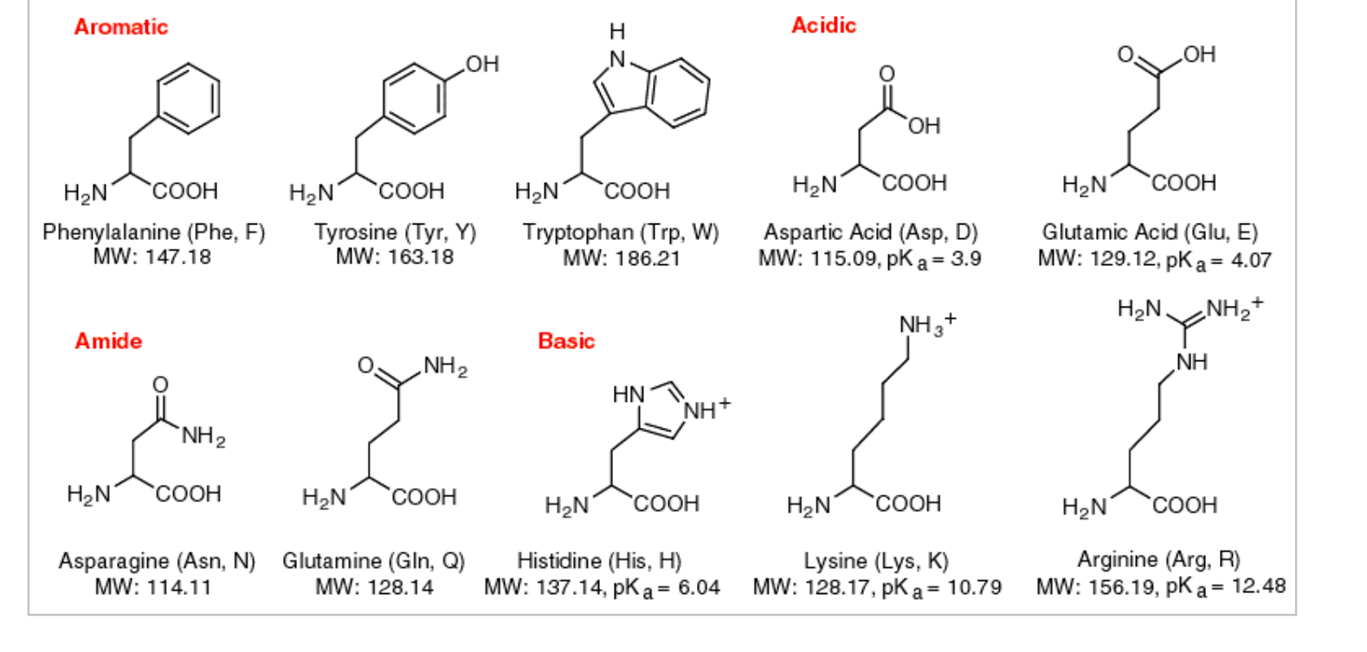
Figure 2. Diagrams showing combinations of amino acids to peptides, peptides to proteins, and proteins to bacterial cell components.

Figure 3. Chirality in the simplest of the amino acids, alanine
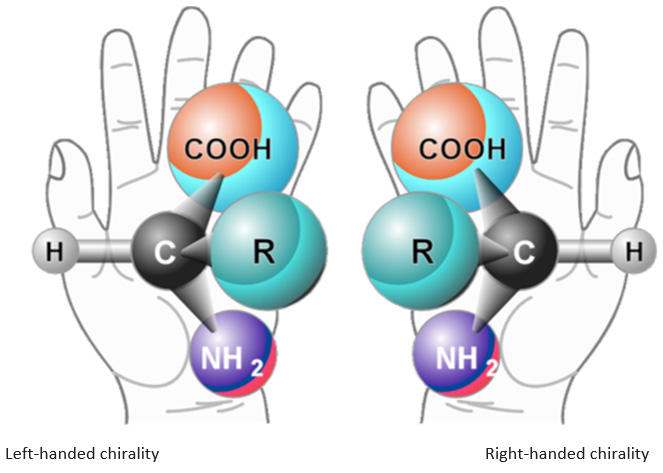
Figure 4. Stanley Miller in his UC San Diego laboratory with his glassware apparatus. A schematic of the apparatus is shown to the right.
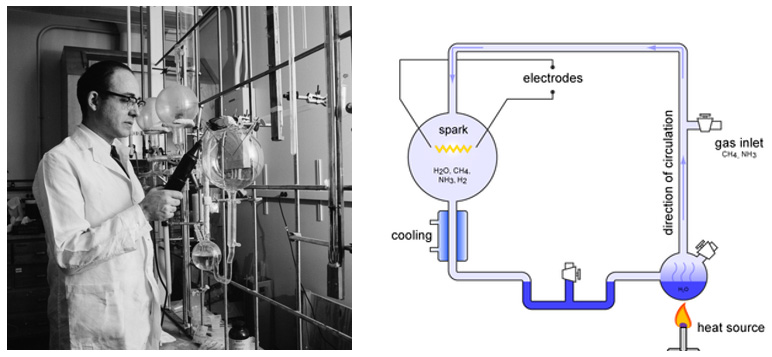
Photo From: Special Collections & Archives, UC San Diego, La Jolla, 92093-0175 (https://lib.ucsd.edu/sca) Schematic Drawing from Wikipedia7