
In Parts 4 and 5 we addressed “Origins” –the fourth item on the following list of “proofs” of evolution that were presented during the 1970’s at Texas A&M where I attended. “Origins” is the study of how life might have begun on Earth strictly through natural and inorganic (abiotic) means. The final blogs in this section focus upon the fifth “proof.” Our professors claimed that the fossil record (the fossilized remains of ancient life forms) provided clear evidence of Darwinian evolution.
Macroevolutionary “Pros”
- Microevolution (Adaptation, Natural Selection)
- Homologies
- Embryonic Similarities
- Origins / (Stanley Miller Experiments)
- Fossil Record
I shared in the first blog of this Evolution series (#25) how one professor asked our class to track the gradual change in the shape of a fossilized foraminifer shell in the overlying, younger sediment from a petroleum industry core. He claimed the change was visual proof of evolution. And it was… of microevolution, not macroevolution as we discussed.
Today, we’ll dive into the earliest evidences of life in the fossil record. Darwinian evolution predicts a gradual change throughout geologic history, within and between major classifications of organisms. Let’s see how these changes, and evidence of the origin of life itself are observed in the fossil record. And, once again I’ll speak as a geologist using geological terminology; I’ll reference great ages of billions of years before present.
When Did Earth Become Hospitable for Life?
Current studies suggest that Earth was formed by the gravitational assimilation of rocky debris shortly after the sun’s ignition, according to the Nebular Hypothesis.1 The age of the Earth is projected to be 4.54 Ga (4.54 billion years) and its surface is proposed to have been molten (i.e. lava), inhospitable to life, and frequently bombarded by residual solar debris.2 This initial stage in Earth’s formation is appropriately termed “The Hadean Period” (origin of name seems obvious; for additional reading see Blog #’s 21 and 22: The Creation Event).1,2 The oceans are believed to have formed as boiling masses of water as early as 200 million years after Earth’s creation. The first evidence of a solid landmass is based upon tiny grains of the mineral zircon at an age of 4.404 Ga in the Mount Narryar region of Western Australia. The grains occur in metamorphosed quartzite as remnants of a previously eroded rock mass.
Many scientists believe that the Earth and the other inner solar system planets were heavily pummeled by comets, asteroids, and meteorites during a “Late Heavy Bombardment” event between 4.28—3.8 Gya. An alignment between Jupiter and the outer giant planets is proposed to have attracted and directed incoming solar debris toward earth and the inner planets. Evidence of the bombardment is visually observed as myriads of ancient craters on the surface of the moon and the other inner planets. It possibly re-melted at least some portion of the Earth’s surface, and with extended levels of active volcanism, the event likely made earth’s surface inhospitable to life and its origin.2 The extremely high melting point of zircon preserved the grains against surficial melting.
Whether life began abiogenically (strictly through inorganic processes) or through God’s design and implementation, researchers speculate that it might have begun within or near submarine hydrothermal vents as early as 4.2-4.0 Gya. The submarine environment would offer protection from both the Bombardment and the strong ultraviolet radiation from the young sun. The vents also supply large amounts of nutrient-rich elements. If life began on the land surface, it likely had to post-date the Bombardment—probably 3.9 – 3.8 Gya.2 When does life first occur? Continue onward.
Earliest Evidence of Life in the Fossil Record
The earliest remnants of life in the geological record do not include spectacular, exotic shells, bones, teeth, or other recognizable structures. Rather, they occur as tiny grains of graphite (a.k.a. your pencil lead)—as unusual spherules encased within another resistant mineral, such as quartz. Their carbon isotope ratio makes them especially unique.
Natural carbon occurs as three isotopes: Carbon-12, -13, and -14 (e.g. C12). Carbon14 is used for age-dating and is often controversial. Carbon12 and C13 are the predominant isotopes. Carbon12 is the lighter isotope and energetically favored in biological processes. Hence, living creatures preferentially utilize C12; their remains are enriched in C12 (or depleted in C13) over abiogenic (non-life) standards by 20-25 per mil.
Currently, Earth’s oldest life remnants are found, once again, within the tiny zircon crystals of Western Australia.3 Advanced electronic microscopy analytical methods have identified graphite spherules in the zircon grains (discussed above) with an age of 4.1 Ga (Figure 1). Not only is the association unusual, but the C-isotope ratio is indicative of life (C13/C12 = -25 per mil; see Figure 2). The original life form is now unidentifiable (its organic carbon remnants have been metamorphosed into graphite), but its depleted C13 signature imply this is perhaps the earliest record of life.
And what was the original life form? Examples of very early life from other environments suggest it was single-cellular, iron-oxidizing bacteria or cyanobacteria.
Life’s Advancement Throughout the Archean and Proterozoic Eons (4.0 – 0.5 Gya)
Your eyes may be rolling backwards at this point, “All this technical information about the earliest remnants of life—and now we’re covering 3.5 billion years of recorded history?”
Don’t despair. The changes are not as dramatic as you might expect.
* * *
So far, our examples of early Earth and its earliest organisms come from Western Australia. Now, we move to the Nuvvuagittuq Supracrustal Belt (NSB) in northeastern Canada.
The NSB represents a rare and tiny sliver of the Earth’s primitive oceanic crust. The NSB is composed predominantly of basaltic metavolcanic rocks including preserved pillow lava structures. It is indicative of a submarine setting, with chemical sedimentary units including iron formations and minor jasper (quartz-rich rocks with hematite and magnetite) and carbonate-bearing iron formations. The minimum age for the belt is 3,774–3,751 Gya. Within this setting are the remains of hydrothermal vents, and within the wall of the vents are amazingly preserved specimens of early iron-metabolizing bacteria (Figure 3a).4 These specimens also include graphitic spherules, hematite (iron-oxide), and silica (Figure 3b). Discoveries of several other sites from 3.7 – 3.4 Gya also include biogenic graphitic spherules.
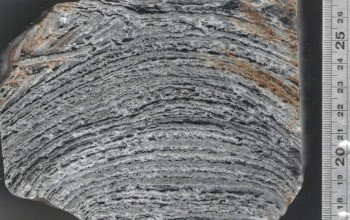
Western Australia and the Pilbara region also contain rocks of this age. In 2006, finely layered structures called “stromatolites” were discovered within 3.48 Gya strata (Figure 4a). The layered sediment alternates between graphite and carbonate or other sediment (Figure 4b). Again, the graphite has a biogenic isotope signature. In this case, we know the type of bacteria that were likely responsible for the structure. Modern-day stromatolites occur in shallow, saline environments such Sharks Bay, Australia. Photosynthetic cyanobacteria (also called “blue-green algae”) form thin organic mats that coat a structure, and continue to grow, layer-by-layer until the structure resembles a dome, or “biscuit” (Figure 5). Polished thin-sections of some stromatolite matrices contain fossilized bacteria which closely resemble today’s cyanobacteria.
Where We Go From Here
You might have noticed that I stopped with stromatolites at 3.48 Gya instead of 0.5 Gya. That’s because from 3.48 to about 0.75 Gya, the progression of living organisms in the fossil record seems to stall. At around 3.0 Gya, a progression occurred from prokaryotic to eukaryotic single cell bacteria. The nucleus and organelles within a prokaryotic cell are not contained within a membrane; examples include cyanobacteria. Eukaryotic organisms, such as green algae have the nucleus and its DNA surrounded by a membrane. I suspect the evolutionary biologists would take offense at my simplification of the lack of life’s progression; but, what I shared is certainly the big picture.
So, let’s summarize what we’ve learned up to this point about evolution in the fossil record:
- Bacteria “life forms” seemed to spring into existence almost immediately after Earth became hospitable, as determined by the severity and length of the Late Bombardment period.
- Evolutionary biologists quickly point to the “early” emergence of life, and yet remain silent on the origin of proteins, their assemblage into cellular organelles, and the establishment of single-cellular life itself in such a brief time.
- And that’s where life remained for the next 3(+) Gya – single cellular organisms only.
I must also mention that during the 3 Gya period, the Earth itself was changing. The photosynthetic cyanobacteria were performing their duty—the introduction of oxygen into an anoxic ocean. Huge volumes of banded iron formations (BIFs – ironstone rocks of various compositions) were globally deposited as the oceans switched from anoxic to oxygen-enriched water. Many believe this was an unavoidable act of nature. Others believe that God was preparing the Earth and its oceans for a myriad of advanced, multicellular life forms. We’ll examine how the introduction of those advanced forms are recorded in the fossil record… and the tribulation it has caused many biologists.
1Wikipedia: Nebular Hypothesis; https://en.wikipedia.org/wiki/Nebular_hypothesis
2Wikipedia: Abiogenesis; https://en.wikipedia.org/wiki/Abiogenesis
3Elizabeth A. Bell, Patrick Boehnke,a T. Mark Harrison, and Wendy L. Mao; Potentially biogenic carbon preserved in a 4.1 billion-year-old zircon; Earth, Atmospheric, and Planetary Sciences, 2015 Nov 24; 112(47): 14518–14521; Published online 2015 Oct 19. doi: 10.1073/pnas.1517557112
4Dodd, MS, Papineau, D, Grenne, T et al. (2017) Evidence for early life in Earth’s oldest hydrothermal vent precipitates. Nature, 543 (7643). pp. 60-64. ISSN 0028-0836
5Nature, 2006: www.nature.com/nature/journal/vaop/ncurrent/…/nature04764.html
Figure 1. Transmission X-ray image of graphite grains in zircon. Carbon isotope analyses of the spherules imply they originally were life-based organic carbon (see Figure 2; below). 1
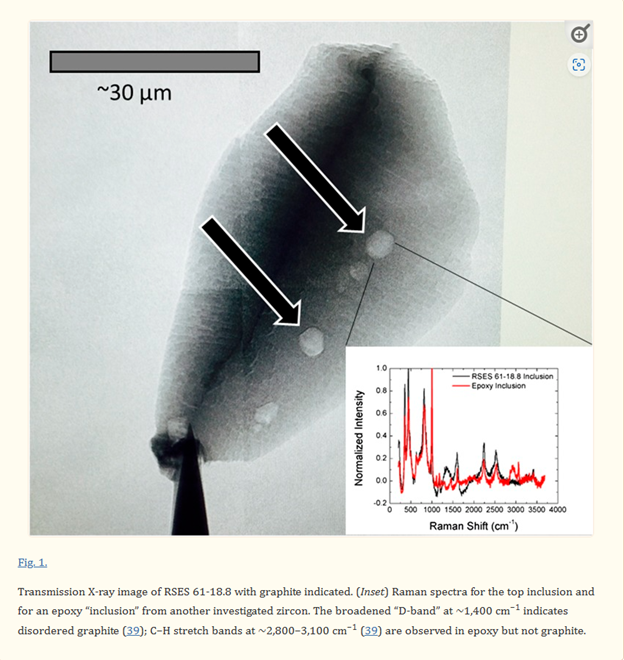
Figure 2. Carbon isotope analyses of carbon spherules in 3.8 (+) Ga years host rocks. The age and carbon isotope analyses of graphite spherules in zircons from the Jack Hills in western Australia (see Figure 1) suggest that life was already in existence at 4.1 Ga years.1

Figures 3a and b. Earliest examples (3.77. Gya) of probable iron-metabolizing bacteria from the walls of ancient hydrothermal sea-floor vents in metamorphosed geologic strata. Nature, 543 (7643). pp. 60-64. ISSN 0028-0836.

Transmitted light images of haematite filaments from the NSB and Løkken jaspers. a, Filaments from the NSB attached to a terminal knob (arrow) coated with nanoscopic haematite. b, Filaments from the Løkken jaspers coated with nanoscopic haematite and attached to terminal knobs (red arrows) and branching (orange arrows). Inset, multiple filaments attached to a terminal knob. c, Filaments from the NSB in quartz band with haematite rosettes (green arrow). Inset, branching filament (orange arrow). d, Filament from the NSB enveloped in haematite (inset, same image in cross polars). e, Filament from the NSB attached to iron oxide band and coated with haematite.
Figure 3b. (Nature, 543 (7643). pp. 60-64. ISSN 0028-0836)
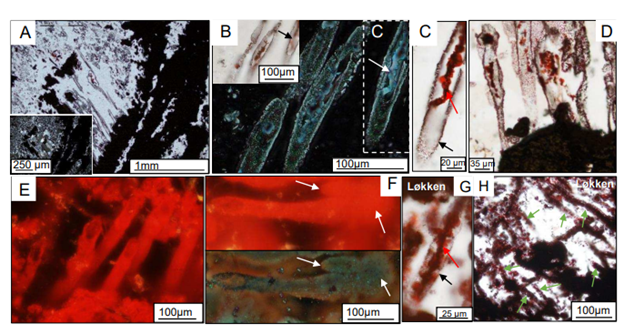
Transmitted light images of haematite tubes in the NSB and Løkken jaspers. a–f, Tubes from the NSB. a, Tubes associated with iron oxide band. B, Depth reconstruction of tubes with haematite filament (arrow). Inset, image of tubes at the surface. c, Tube showing filament (red arrow) and walls (black arrow). d, Strongly deformed tubes. e, Depth reconstruction of tubes. f, Two tubes attached to terminal knob (arrows); lower image taken in false colour. g, h, Tubes from the Løkken jaspers. g, Tube with haematite filament. h, Aligned tubes (green arrows).
Figures 4a and b. Outcrop of stromatolite in Western Australia and slabbed section (4b) showing alternating layers of graphite and carbonate(?).
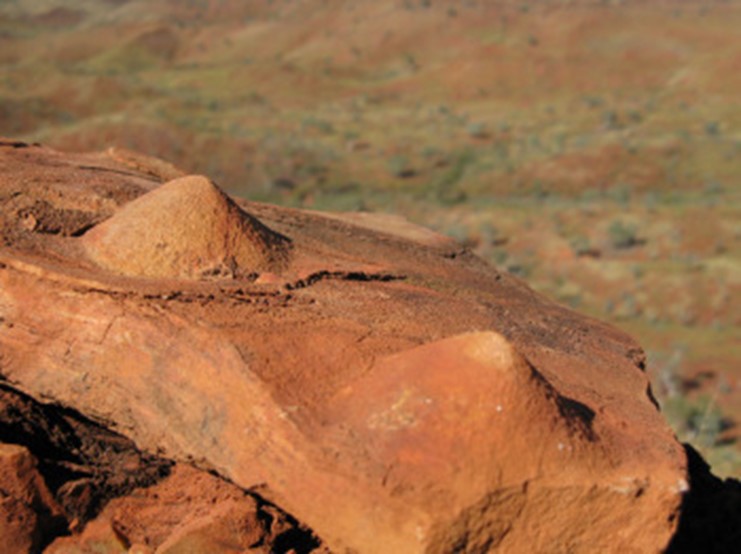
Figure 4b.
Nature, 2006: www.nature.com/nature/journal/vaop/ncurrent/…/nature04764.html
Figure 5. Modern-day stromatolites from Sharks Bay, Australia. Also shown are “strings” of the present-day Cyanobacteria.
