The first ten years of marriage between Jana and I were a period of stretching and adjustments, as with many couples. Her role as a stay-at-home mom with our two young daughters was a heroic task. I became a workaholic at the research lab, dominated by deadlines, schedules, and pressure. Too many weeks were spent away from home on business trips as I intently focused on my career. Jana craved my attention and adult conversation. We needed focused time together.
We decided to take a week-long dream trip to an all-inclusive, Caribbean resort on St. Kitts for our tenth anniversary. Once on the Island, we began to reconnect. Jana is a vivacious sparkplug and we participated in many of the resort’s activities. I began to relax after a couple of days without the pressure of a job… and I ached for sleep. Napping on the beach under a palm tree became one of my favorite afternoon activities. It was “no problem, mon.” Time sleepily drifted by as I snoozed on a beach pad in the sand. No clock ticks, no alarms, and no schedule—time became a meaningless entity with no authority over my life. This was “island-time.”
Many folks identify with this concept of “time” and rationalize, “It’s simply a measure we use to schedule a future meeting;” or, “It’s a record of how long my car was in the shop.” However, “time” is a much deeper concept than one might imagine, and it’s been the source of many vicious arguments. In this blog, we focus on the third leg of truth on our three-legged stool—truth through Creation. Specifically, we begin with a discussion of “time” as viewed through physics. We’ll consider Earth Science as our next discipline of creation and conclude with astronomy.
* * *
C.S. Lewis is one of my all-time, favorite authors. You may be familiar with the two films, “Chronicles of Narnia” and”Shadowland”—they feature his writings and his life. His books include quotes from both classical and obscure European writings that glaze the eyes of this Texan-speaking reader. I admire him because he explored deep theological concepts and was a master at relating them to his or others’ lives and events.
Miracles1 is one of Lewis’ books that gripped me. It addresses God’s periodic intervention within His Creation. One intriguing paragraph in an early section has great relevance to the field of physics. The text follows:
… The question is whether Nature can be known to be of such a kind that supernatural interferences with her are impossible. She is already known to be, in general, regular: she behaves according to fixed laws, many of which have been discovered, and which interlock with one another…1
Even as a non-technical, literary giant, C. S. Lewis understood that God’s creation includes natural laws with multiple parameters. And, since several equations may employ one or more of the same parameters, the equations and parameters are linked. An example of “interlocked parameters” is evident in a popular equation that Albert Einstein published in his Theory of Special Relativity (1905). His equation and the parameter names are shown below:
E = mC2
Energy = mass * (speed of light)2 [speed of light = distance / time]
Or
E = m*(distance / time)2
Did you notice the amazing brilliance of Einstein and the insight of C. S. Lewis? Einstein tied the four basic entities of our universe—energy, mass, distance, and time—into one elegant equation. And C. S. Lewis recognized that the entities are all interlocked. In other words, you can’t change the value of one parameter, such as time, without changing the value of energy—they are all linked and related to each other.
This smashes our concept of meaningless “island time!”
Time is a real, physical entity and a component in the framework of our universe. For example, time is a parameter in the gravitational constant of Earth, the sun, and the other planets (this constant reflects the strength of the force of gravity; or, how fast you hit the ground from a two-story building!).1
Time also had a beginning. Creation points to it and the Bible declares it. Consider the following verse from the book of Jude:
Jude 1:24, 25 Now to Him who is able to keep you from stumbling, and to make you stand in the presence of His glory blameless with great joy, to the only God our Savior, through Jesus Christ our Lord, be glory, majesty, dominion, and authority, before all time and now and forever. Amen.
Verse 25 clearly acknowledges that our Lord Jesus Christ existed “before all time.” In other words, time began at the Creation Event. This has important implications that we will address in future blogs.
Finally, time is “relativistic”—it changes with the frame of reference. Consider these examples:
Example 1
You are selected to participate in the first interstellar mission of a new generation rocket. You and your colleagues will fly through space at 99.9999% of the speed of light. This is a lifetime assignment—you will visit five stars and their planets. And, since the mission will require 50 years, you bring along your calendar and an alarm clock. The mission is a success and your clock and calendar show that you have returned to Earth precisely 50 years after your departure… to discover that 20,000 years have passed on earth.
Example 2
You have a second space travel option. An extremely massive planetary body has intersected our inner solar system, so dense that time itself is warped. A mission is established to visit the object—but there is a twist. It resides so closely to earth that NASA will watch your activities on the planet with a huge telescope. Upon arrival, you discover that the gravity is crushing, over 300,000 times greater than earth’s gravity. And then, a few startling observations are made from earth. Three minutes pass-by according to your wall clock. On earth, the same three minutes are equivalent to two years. The earth observers note that as your heart takes its second beat—theirs have beaten about 350,000 times. They see you as essentially motionless—you watch them, and they are moving as a blur.2
These examples reflect the relative nature of time. Time drastically slows down when traveling extremely fast or upon entering a massive gravitational field. A third natural mechanism also greatly slows the passage of time. We’ll introduce and discuss it in future blogs.
Finally, as residents of earth, we travel along a one-dimensional timeline. We can’t leave the line nor move backward – it is our frame of reference. God, however, is not constrained by a single time dimension. Peter penned the following statements about God and His relationship to time:
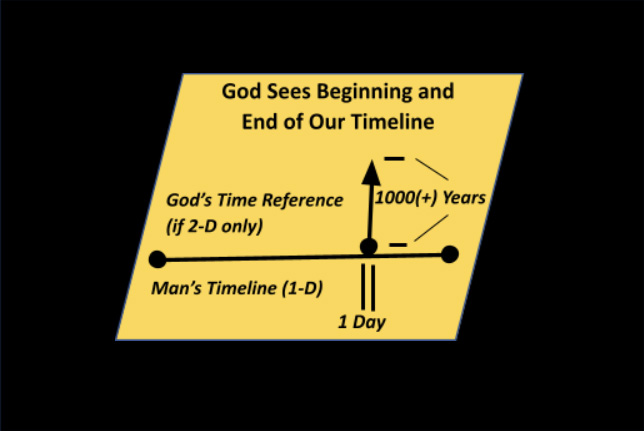
2 Peter 3:8 “But do not let this one fact escape your notice, beloved, that with the Lord one day is as a thousand years and a thousand years as one day”. God is not constrained by time. A simple illustration is presented in Figure 1, which assumes God occupies two, time dimensions. As we progress through one day on our timeline, God is free to spend a thousand years in the second time dimension. God is not limited even by multiple time dimensions, as shared by Isaiah—He sees the beginning and the end simultaneously:
Isaiah 46:9-10 . . . I am God, and there is no one like Me, declaring the end from the beginning, and from ancient times things which have not been done. . .
Hopefully, this discussion has expanded and enlightened your concept of “time” and its complexity. It’s as important a variable in the structure of the universe as mass or energy. Part 2 will introduce the concept of time within our specific frame of reference—the Earth.
1Lewis, C. S. Miracles; p. 87; Harper Collins, 1947
2Wikipedia; Gravitational Constant; https://en.wikipedia.org/wiki/Gravitational_constant
3Schroeder, Gerald, L. The Science of God; Free Press, 1997
Figure 1. A simple representation of the nature of God assuming He is confined to two, time dimensions. God sits above the dimensions of time and simultaneously” sees the end from the beginning.” (Isaiah 46:9-10)