In Part 2 we considered Earth’s amazing magnetic field, our idealized atmosphere, and their combined ability to screen out practically all the dangerous radiation bombarding our planet. In addition, our atmosphere is perfectly designed with a gas composition that not only removes the incoming x-ray and high-energy gamma radiation but is transparent to visible light and radio waves. These latter wavelengths are required for our survival. Paul Davies, a well-known theoretical physicist, quoted that the evidence for design (by God – JRC addition) could be “considered as overwhelming.”
NASA, however, attributed these amazing “coincidences” to luck. The agency’s comment follows:
In addition to a protective atmosphere, we are also lucky that Earth has a magnetic field. It shields us from the full effects of the solar wind and GCR. Without this protection, Earth’s biosphere might not exist as it does today, or would at least be limited to the subsurface.1
“Lucky?”
This final paper in the series Undeniable Fingerprints focuses upon just how “lucky” we really are—so “lucky,” in fact, that statistics say it’s impossible. We’ll examine several stunning examples of design for human life in intergalactic space, our solar system, our moon, and our planet. Several references will also be provided which tally hundreds of examples of design throughout nature, and their statistical probability of occurrence.
In the end, God’s Word provides a very different explanation of how and why so many natural criteria just “happen” to work together to promote mankind’s existence. I shared the passage in Part 2 and include it again below (italicized explanations of the Hebrew verbs are included – JRC).
Isaiah 45:18
For this is what the Lord says – He who created (bara – spoke into existence from nothing) the heavens, He is God; He who fashioned (yatsar – to squeeze/mold into shape, esp. as a potter) and made (asah –to make; from pre-existing material) the earth, He founded it (kuwn – arranged / established): He did not create (bara – spoke) it to be empty, but formed (yatsar – potter) it to be inhabited.
The incredible wisdom of God in “forming Earth to be inhabited” is evident throughout His creation if we only look! And that’s what we’ll do.
* * *
Generally, I share 15-20 examples of design in the Science and the Bible lectures. However, due to the brevity of these documents I’ll only provide a small subset in Part 3. We’ll begin in deep outer space and conclude on earth.
Intergalactic Space
You may have never considered that outer space (outside our Solar System) can impact life on this planet. Reflect upon these examples:
Small, Isolated Galaxy Cluster. Most galaxies occur in giant clusters. Collisions and gravitational interaction between the galaxies disrupt the galactic habitable zone (discussed below) and diminish opportunities for life. Stephen’s Quintet is a group of five galaxies that demonstrate an active collision between two of its members (Figure 1). The collision has generated a galactic shockwave larger than our galaxy and millions of degrees in temperature—so hot that it generates x-rays.2 Our “Local Group” includes only two major galaxies—our Milky Way galaxy and Andromeda. The chance of being in a small, isolated cluster like ours is estimated to be one in one-thousand (1:1000).
Spiral versus Elliptical Galaxy. We discussed in Part 1 of this blog the devastating x-ray radiation that permeates the elliptical M-87 galaxy (Figure 2a). Each star within the galaxy is within line-of-sight of the galaxy’s core and its massive, radiation-generating black hole. This phenomenon occurs within many/most elliptical galaxies. A spiral galaxy (Figure 2b) provides a shield against radiation (discussed below). It is estimated that only 6% of today’s galaxies are spiral—like our Milky Way.
Galactic Habitable Zone. Even if you are fortunate enough to live in a spiral galaxy, only one region within it is considered favorable for life. Figure 3 shows a nearly perpendicular view of the beautiful Whirlpool Galaxy. In 2001, Guillermo Gonzalez published a captivating article that was eventually re-published in the Scientific American Journal.3 He described a very narrow zone of stars that are stable and possibly suitable for life. Stars in the habitable zone are a safe distance from the core of the galaxy and shielded from its massive radiation by the dust. And yet, stars in the zone are close enough to the core to have rocky material available for planet formation. Huge dust clouds occur outside of this zone, nearer the spiral arms; star formation and deadly supernovas occur within the arms of the spiral. The stars within this narrow habitable zone must rotate at the same rate as the spiral arms, otherwise they will be overtaken and swallowed-up. The blue circle in Figure 3 depicts the habitable zone.
Finally, the stars in the zone must travel exactly in the plane of the galaxy (Figure 4). If a star wanders above or below the plane, in line-of-site with the core, it receives heavy radiation dosages as occurs with M-87. Stars in the habitable zone must remain in the galactic plane.
Our Solar System
The Sun. We have an amazing star specifically designed for our survival. Astronomers have identified a complex sequence of star types that covers a huge range of star sizes, temperatures, and stability. The “Hertzsprung-Russell” diagram (Figure 5) summarizes the sequence. It ranges between cool, small “red” stars (Class M) on one end to the giant, extremely hot “blue” stars (Class “O”) on the other end. The red stars are too cool to promote life within a habitable zone (discussed below), and the large, blue stars are unstable, expanding and collapsing in cycles. The chance of having a Class G star is estimated at 1:1000. Furthermore, most stars are binary (two stars rotating around each other) which disrupts/ destroys the planetary orbitals. Approximately 18% are single (bachelor) stars. We have a bachelor, “Class G” star which is perfectly positioned in the intermediate range with just the right temperature, size, and stability to protect and promote life on earth.
Our Interplanetary Habitable Zone. A narrow zone also exists within a star’s solar system of planets that favors life, quite analogous to the habitable zone within a galaxy. It is generally believed that life requires water in the liquid state for long term survival. The habitable zone within a solar system of planets is determined by the classification (temperature) of the star, the distance from the planets to the star, and their orbits (circular versus elliptical). Our planet (Earth) has a near-circular orbit that is perfectly positioned at a distance to receive continuous heat to sustain life on its surface—which is approximately 75% covered by liquid water.
Jupiter, Our Sentinel Planet. Have you ever been in a circumstance where you needed physical protection against a dangerous threat? All of humanity faces such a threat. Comets, asteroids, and other rocky debris captured by the sun’s gravity speed toward the sun and through the orbits of the inner planets like an astronomical cannonball. A collision with Earth would devastate, and perhaps extinguish mankind, as proposed with fate of the dinosaurs. Fortunately, we have a massive planet, Jupiter, in our outer solar system that functions as a giant shield to deflect or capture these intruders.
A spectacular example was observed in July 1994. Jupiter had captured the Shoemaker-Levy comet 7 probably 20-30 years earlier; and since then, it circled the planet every two years in large, elliptical orbits. In July 1992, a very close encounter with Jupiter broke the comet into at least 25 fragments; a few exceeded one mile in diameter (Figure 6). Computer simulations suggested that during its next orbit in July 1994 the comet would collide with Jupiter.
Telescopes around the world were focused on Jupiter during the latter half of July 1994. They recorded the first-ever images of massive fireballs and earth-sized scars during July 16-22 as the comet projectiles rocketed into Jupiter’s dense atmosphere at 37 miles/second (Figure 7). The fireball from the largest comet fragment was one-quarter the size of the earth and had a calculated energy release of 6,000,000 megatons of TNT—600 times larger than the world’s nuclear arsenal.
God knew that mankind’s existence on Earth required a “cosmic vacuum cleaner” (as some refer to Jupiter8). Scientists calculate that Jupiter receives 2000-8000 more impacts over a given period than Earth. However, if Jupiter were larger or any closer to Earth it would become a menace. Its huge gravity would rip our planet out of her stable orbit within the habitable zone.
Does all of this seem a bit “coincidental?” Once again, scientists estimate the odds at 1:1000.
Our Moon
Earth’s “planet-moon relationship” has been referred to as “unique.” We have a huge moon relative to the size of our planet—so large that it would be impossible for Earth’s gravity to capture it. And yet, here it is, providing many contributions for life on our planet.
So, how do we even have “a moon” that illuminates our night-time sky? That’s another design miracle to be addressed in a future paper. For now, here are a few of the positive attributes for life which are provided by the moon. Others are included via reference in the last section:
- Stabilizes Earth’s axial tilt (otherwise, Earth would “wobble like a top”).
- Ocean tidal flushing and nutrient regeneration.
- Climate stabilization.
Our Earth
Again, dozens of design “miracles” allow life to flourish upon our planet. We previously considered Earth’s incredible magnetic field and amazing atmosphere that protect us from harmful radiation (Part 2 in this series). Here’s a list of a few others—many more are referenced in the following section:
- Perfect size (mass). Any larger and Earth would retain too much methane and ammonia, causing a runaway greenhouse effect. Any less, and Earth would lose its water.
- Perfect rotation period (24 hours). Any faster, and wind speeds would drastically increase on Earth’s surface. Any slower, and daytime/night-time temperatures would drastically increase and decrease correspondingly.
- Thickness of planetary crust and plate-tectonics mechanism. This allows for ocean nutrient regeneration, mineral resources, and surface stability of Earth’s crust.
* * *
Hopefully, by now you have questioned how and why mankind received so many “lucky breaks” for our existence in this section of the universe. If so, you are in excellent company with many scientists—they coined the term “Intelligent Design.”
Hugh Ross is an astrophysicist and founder of the Reasons to Believe (RTB) organization. He concluded, as a former atheist, that the only possible explanation is that a God must exist, and that He designed and founded our planet for mankind’s survival (just as Isaiah 45:18 describes). Ross laboriously compiled extensive lists of these technical miracles and their references from the technical literature. And finally, he calculated the statistical probabilities of their individual and combined occurrence simply by chance. These extensive lists, references, and probabilities are provided on the RTB website at the following link:
RTB Design Compendium (2009) – Reasons to Believe
As a quick summary, Ross provides the following lists of criteria that must be present and finely tuned to support life:
- The Universe – A list of 140 features of the universe (including several laws of physics) must be present and narrowly constrained
- A Galaxy and Planetary System – 402 parameters must be extremely fine-tuned to support intelligent life
- A Galaxy and Planetary System (Probability Estimates) – 922 criteria are identified that must be present to support life; probabilities of their occurrence are also provided, based on the specific requirements of three different groups of life forms.
- Probability Estimates at Different Size Scales – Probability estimates for the 922 criteria (see above) are provided for features at various size scales; e.g. galaxy cluster, galaxy, star and solar system, moon, planet, planet surface, etc.
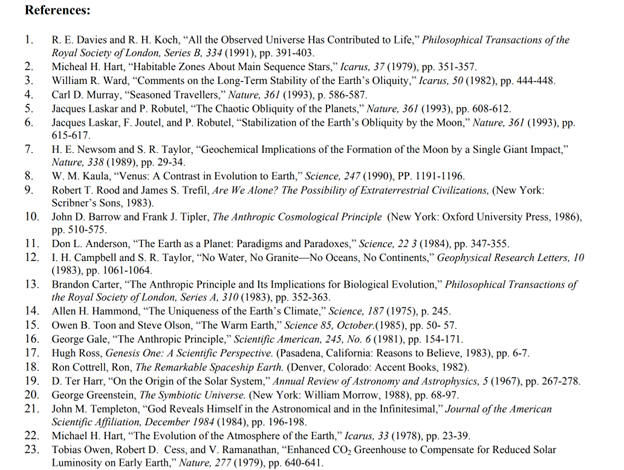
An example from No. 3 is provided in Figure 8. At least 501 criteria are required to be finely tuned to sustain even simple, bacterial life for a few months. Figure 8 includes the first page of 501 criteria (out of the 922) with each criteria’s probability of occurrence. Figure 9 provides the first page of technical references from which the criteria were identified. And finally, the following example presents the combined probabilities for the 501 criteria deemed necessary to support bacterial life for a few months:
And, Yes!! That’s one chance in 10, followed by 311 zeroes, that one planet anywhere in the universe could possess these 501 finely tuned criteria and sustain simple bacteria growth for a few months without God’s intervention. We think of one chance in a million (six zeroes) as being unfathomably lucky. Can you even begin to comprehend one chance in a number with 311 zeroes?
So, returning to the opening question in this document, are we just “Lucky?” as the NASA report claims? Many honest scientists believe otherwise. The statistics demand another explanation—exactly as offered by Isaiah:
Isaiah 45:18
For this is what the Lord says – He who created (bara – spoke into existence from nothing) the heavens, He is God; He who fashioned (yatsar – to squeeze/mold into shape, esp. as a potter) and made (asah –to make; from pre-existing material) the earth, He founded it (kuwn – arranged / established): He did not create (bara – spoke) it to be empty, but formed (yatsar – potter) it to be inhabited.
1 NASA Why Space Radiation Matters; https://www.nasa.gov/analogs/nsrl/why-space-radiation-matters
2 Wikipedia; Stephen’s Quintet; https://en.wikipedia.org/wiki/Stephan%27s_Quintet
3Guillermo Gonzalez (2001), In Search of the Milky Way’s Habitable Zone, NASA Astrobiology News, May 24, 2001.
4Wikipedia; Atmosphere of Earth; https://en.wikipedia.org/wiki/Atmosphere_of_Earth
6 Paul Davies (1983); God and the New Physics; Simon and Schuster.
7Comet Shoemaker-Levy 9; https://en.wikipedia.org/wiki/Comet_Shoemaker%E2%80%93Levy_9
8Davis, Matt; Why Humanity Owes a Lot to Jupiter (Nov. 9, 2018), Bigthink.com; https://bigthink.com/surprising-science/how-jupiter-protects-earth?rebelltitem=1#rebelltitem1
Figure 1. Galactic wreckage in Stephan’s Quintet. A collision among the members of a quintet galaxy cluster reveals an assortment of stars across a wide color range, from young, blue stars to aging, red stars. The blue arc across the top center is a shock wave caused by colliding intergalactic gas. Image Credits: X-ray (blue): NASA/CXC/CfA/E. O’Sullivan Optical (brown): Canada-France-Hawaii-Telescope/Coelum. (From Wikipedia; Stephen’s Quintet; https://en.wikipedia.org/wiki/Stephan%27s_Quintet).
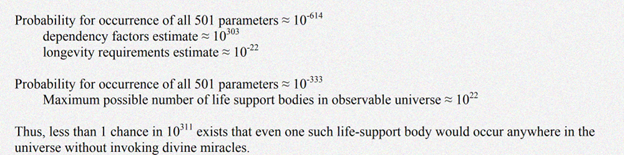
Figures 2a and b. Examples of an elliptical galaxy (M-87) and a spiral galaxy (Andromeda).
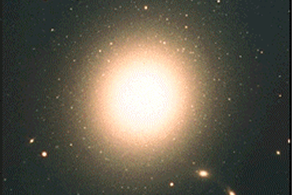
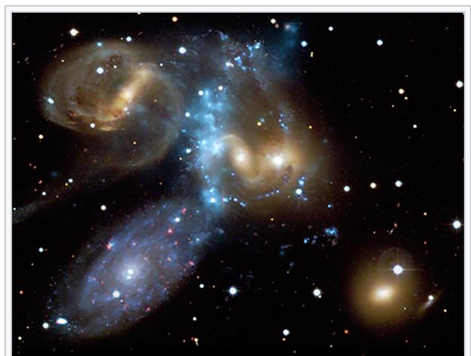
Figure 3. The beautiful, spiral Whirlpool Galaxy. The view is almost perfectly perpendicular to the plane of the spiral. The blue circle is a general representation of the galactic “habitable zone.”
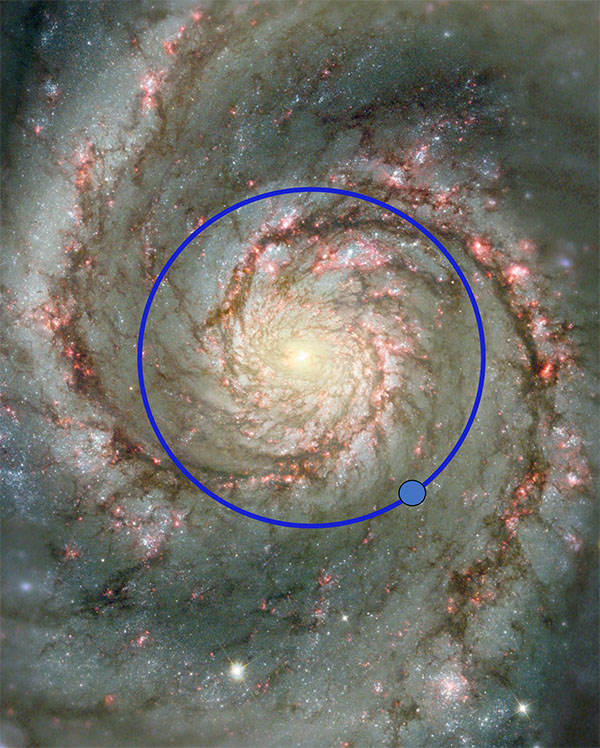
Figure 4. An “edge on” view of the NGC 4031 galaxy. Stars within the habitable zone must remain in the plane of the galaxy and not wander above or below it (see text).
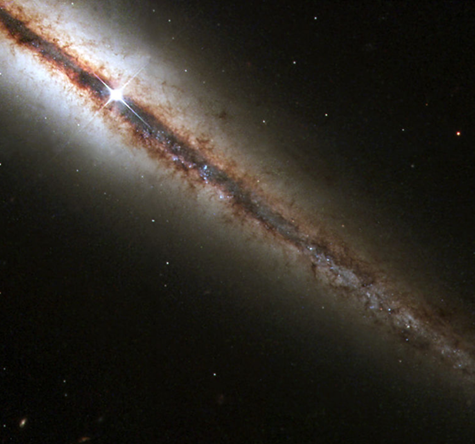
Figure 5. Hertzsprung-Russell diagram. The figure illustrates the observed sequence of stars, plotted by the star’s luminosity and temperature.
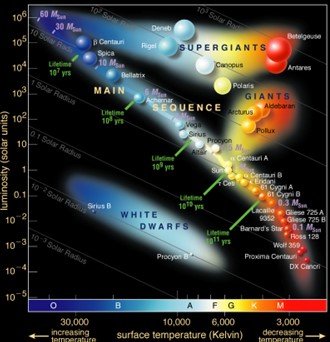
Figure 6. Fragmented train of the disaggregated Shoemaker-Levy comet; photographed by the Hubble Space Telescope (HST) just prior to the comet’s collision with Jupiter.

Figure 7a. Giant fireball as larger comet fragment collides with the planet (the bright object on the right is Jupiter’s moon Io).
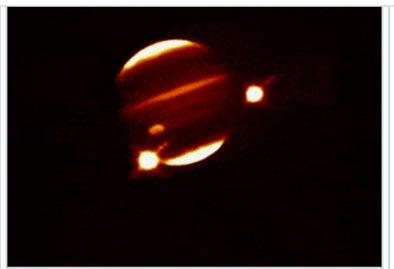
Figure 7b. Transect of Earth-sized scars in Jupiter’s dense atmosphere following the impacts.

Figure 7c. Near-infrared photograph of Jupiter showing elevated temperatures at the comet impact sites (photographed by University of Hawaii, 2.2 meter telescope).
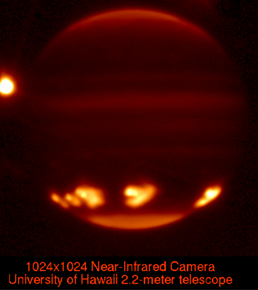
Figure 8. First page of required criteria to support bacterial life and the probability of occurrence (from Hugh Ross; RTB Compedium – see link provided in the text).
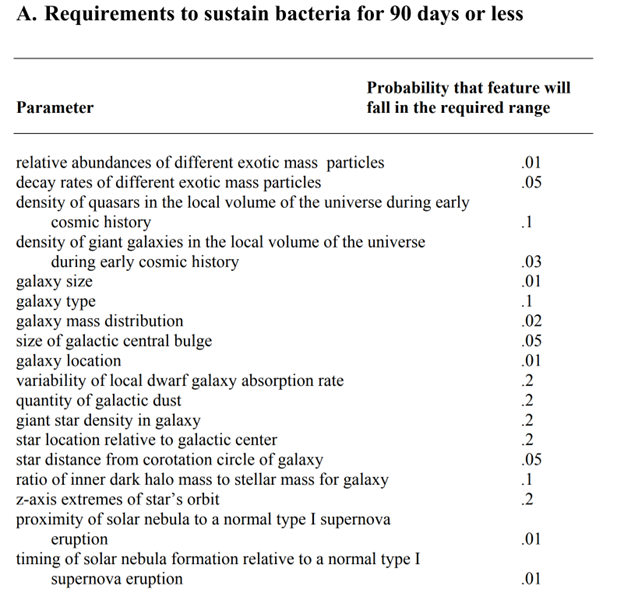
Figure 9. First page of list of references (from Hugh Ross; RTB Compedium – see link provided in text).