
I dubbed the previous section on the Creation Event as perhaps the most important topic of this entire blog series. However, this section on evolution is not far behind. It has also been the most challenging of all the series for this author to compose. I am NOT a biologist—never planned to be, never intend to be! I did complete a few college courses on biology and botany and three undergraduate/graduate paleontology courses (the study of fossils – ancient animals) at Texas A&M. But most research biologists would consider my attempt to compose this section as dangerously foolish.
All that said, I do have personal experience with the controversial nature of the topic. It ranges on one hand from the ferocious intensity of a few college professors who rigorously defended evolution, and sadly, often denied God. On the other hand, many teachers in the church vehemently deny evolution on a scriptural basis and yet remain generally ignorant of the scientific complexities around the issue.
Evolution seems to be a topic of perpetual contrasts. Some biologists support evolution and deny God, and yet others support evolution but believe and follow God. A good friend of mine has a Ph.D. in biology, teaches biology in a credited university, defends evolution, and is a strong Christian. Consider, for example, the following topics and the rebuttals by Christian biologists:
Case 1:
Observation: Scripture suggests generational continuity in offspring (they are to produce “after their kind”; Gen. 1:11-12, 21, 24-25)
God-honoring biologists: Change occurs in all organisms as a beautiful expression of God’s handiwork.
Case 2:
Observation: Microevolution is commonly expressed throughout nature, but macroevolution appears to be extremely rare in the fossil record
God-honoring biologists: It’s an artificial division—it’s the same process of change but at different rates
Case 3:
Observation: Abrupt global extinctions and immediate “explosive appearances” of new body types leave no time for gradual evolutionary transitions.
God-honoring biologists: Comprehensive integration across multiple sites suggest “non-immediate” appearances in the fossil record.
Not simple topics, are they? And the rebuttals come from men and women with faith in God—like you and me—who firmly believe in evolution and also believe that God is glorified through it! Suddenly, evolution becomes quite a bit fuzzier than what most of us have heard in church. We’ll return to these topics with more context later.
Evolution—The Inception
When entering college, my knowledge of evolution hinged on the brief biblical passages shared above in Case 1, that God’s creatures should reproduce “after their kind.” That phrase is interpreted within the religious sector to imply that physical/mutational changes should not alter a creature’s lineage.
One of the graduate paleontology courses that I endured was Micropaleontology – the study of microscopic fossil shells of tiny one-celled animals. Oil industry explorationists use the fossils to identify the rock’s age, which helps define the formations they penetrate when drilling a well. I took the course during the mid-1970’s; evolution was taught as fact—there was no debate. Our professor of the “Micro” course seemed to go out of his way to point out subtle changes in the same animal’s shells as you moved upward (to younger levels) within the cuttings or cores from a well. The cumulative changes continued until the animal was classified as a new species. He announced with obvious satisfaction that “this proves evolution – you can see it yourselves!” I remember sitting there feeling disturbed and questioning the scriptures—I could indeed “see the changes myself.” And I was disturbed, because at that time I had never heard of “micro-“ or “macroevolution.”
Charles Darwin and Microevolution
Charles Darwin published his treatise The Origin of the Species in 1859.1 As mentioned in previous blogs, it introduced a phenomenally new perspective on bioscience and the life sciences. Let’s take a closer look at Darwin and his publication.
Darwin was a naturalist (Figure 1) with strong interests in geology, biology (especially marine biology and insects), and botany. Surprisingly, he also had a religious background. His family was Unitarian, and he took numerous religious courses at Cambridge. He was particularly intrigued in the evidences of God through creation and studied William Paley’s Evidences of Christianity (1795) and Natural Theology or Evidences of the Existence and Attributes of the Deity (1802). Darwin was well-studied, fascinated by science, interacted with numerous scientific experts, and even attended geological sampling excursions.
In 1831, Darwin was invited to attend a five-year voyage aboard the HMS Beagle as the science naturalist. The expedition (1831-1836) circled the globe and made multiple stops—the cluster of Galapagos Islands was a notable location. His activities there included several weeks of flora and fauna descriptions, sample collection, and observations of the local bird populations. He recognized changes in the finch and tortoise populations from island to island and began to suspect that the stability of species was questionable. He collected eight different species of finches from the islands.
Darwin began to compile the multitude of samples upon his return to London. He organized his data, delivered presentations, and published papers from his voyage discoveries. He also pondered the finch variations between the islands and later realized that the changes progressed in a southerly direction. The different finch species had adapted to specific food sources as evidenced by differences in their beaks (Figure 2). Darwin also knew that changes in a pigeon species could be implemented through selective breeding.
Over the next 20 years Darwin continued his studies of natural science and the stability of species. In 1838 he recognized that within any population, the struggle for survival would naturally favor those individuals best equipped to cope with the pressure—preserving those individuals while eliminating those that were disadvantaged. He concluded that the process was a natural analog to selective pigeon breeding and termed it “natural selection.” It became a core aspect of his theory.
If you attend a church and are still with me at this point, you may be alarmed by my tone of discussion. It sounds factual and appears to support Darwin and his studies. And you are correct, I do agree with Darwin’s observations as described above—and most likely, you do too.
Have you heard of or experienced one of the following?:
- Development of bacterial resistance to penicillin,
- Development of mosquito resistance to DDT and other insecticides,
- Transformation of the COVID-19 virus into one or more new strains?
I suspect you have.
These three examples and the early observations by Charles Darwin demonstrate natural change within a species. This physically observed phenomenon is termed “Microevolution.” It is observed throughout the animal kingdom, even from generation to generation. Four processes promote the variations:”2
- Beneficial mutation within a DNA sequence – mutations are generally deleterious,
- Migration of individuals away from the population,
- Genetic drift (random changes in gene frequencies from generation to generation),
- Natural selection.
These processes will benefit certain individuals within a population and ensure the population’s survival in a changing environment. Figure 3 demonstrates the advantage of brown beetles over green beetles on brown tree bark—the brown beetles are less impacted by predation.
My “disturbing” Micropaleontology experience discussed above (the subtle changes in the fossil shells within an oil well core) reflected my ignorance of microevolution.
Microevolution does not conflict with Genesis 1—God’s intent for individuals to repopulate “after their kind.” If the beetles in Figure,3 represent a single hatching, they demonstrate natural (God created) variability with the DNA of the organisms. Green or brown—they are still the same beetle. Likewise, Latinos and Anglos represent different cultures, but both are still humans, and a mixed marriage between the two will produce offspring with different traits than either parent.
Microevolution is real, and it’s an observable process in God’s creation. However, Charles Darwin did not stop there. He introduced the concept of “macroevolution,” or the gradual formation of new orders, families, etc. well beyond the species level. We’ll examine it next.
Charles Darwin and Macroevolution
During the 20 years following his voyage, Darwin progressed in his research and speculations around species transmutation—the change of one species into another species. As mentioned above, he was keenly interested in geology and had observed fossil skeletons of giant sloths and other organisms now extinct, but similar to present-day organisms. As early as 1837, he began to draw his “branched tree” diagrams (Figure 4), suggesting change from one organism into a family of very different organisms (a.k.a. “common descent”). In the early 1850’s Darwin identified “homologies,” which he described as slightly changed body parts in very different organisms that now serve different function to meet new conditions (think of five fingers on a hand versus five “fingers” in a whale’s flipper).1 In 1859, Darwin compiled his observations and ideas into the “theory of evolution” and published The Origin of the Species. Listed below is a quotation from the book that demonstrates his view on transmutation across the animal kingdom:
…I see no reason to limit the process of modification, as now explained, to the formation of [species and ] genera alone. These two groups of genera will thus form two distinct families, or orders, according to the amount of divergent modification supposed to be represented…” (Charles Darwin, The Origin of the Species; 1859)
Macroevolution lies well outside the traditional interpretation of “kinds” in Genesis 1 (Figure 5). We’ll examine the process more thoroughly in Part 2 and beyond.
Evolution—Fact (or Fantasy?)
Part 1 of this section began with a discussion of my college paleontology classes, and my confusion during a graduate Micropaleontology class. I was not the only one who struggled. Others, I’m sure, were confused over the apparent scriptural contradiction between “kinds” and the “factual nature” of evolution. But it went beyond that—there were aspects of evolutionary theory that just didn’t make sense with what we were taught in other classes or had observed in our limited field work.
A few of us, even as non-biologists with very little field experience, questioned the professors about several controversial issues (for example, the initial origin of life itself and the Cambrian Explosion). We were assured that previous studies had either confirmed the confusing contradictions, or that more study was necessary to fully understand the issue, or even, “we just haven’t found the right fossils yet, but they’re out there.”
And now, 40 years later, several of the issues that seemed problematic during those college years not only persist today but have become major hurdles that cast doubt even upon the evolutionary progression of species. And that provides a roadmap I’ll follow in this section on evolution. We’ll examine the “proofs” of evolution that we were taught at Texas A&M during the 1970s, and then contrast each “proof” with what we understand today through scripture and through decades of technical study of God’s creation.
In other words, we’ll examine how the field of evolution has evolved over the past 40 years.
And how we still “just haven’t found the right fossils—yet. . . “
1Wikipedia: Charles Darwin; https://en.wikipedia.org/wiki/Charles Darwin
2University of California (Berkeley; 2022): Understanding Evolution; Evolution 101—Evolution at Different Scales
https://evolution.berkeley.edu/evolution-at-different-scales-micro-to-macro/what-is-microevolution/
Figure 1. Photographs of Charles Darwin shortly before his publication of The Origin of the Species, and later in life (from Wikipedia: Charles Darwin; https://en.wikipedia.org/wiki/Charles Darwin).

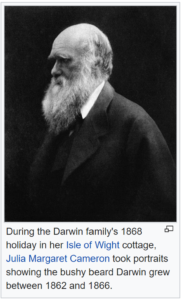
Figure 2. Variations from island to island in the Galapagos Finch beaks that Darwin discovered. (From Wikipedia; photo of Finch from https://www.pbs.org/wnet/nature/blog/are-table-scraps-influencing-the-evolution-of-darwins-finches/)


Figure 3. Natural selection process. The green beetles are more susceptible to predation by birds than the camoflogued brown beetles (from University of CA-Berkeley); https://evolution.berkeley.edu/evolution-at-different-scales-micro-to-macro/what-is-microevolution/

Figure 4. Darwin’s first “branched tree diagram” indicating progressive transmutation of families of animals from ancestors (common descent; from Wikipedia: Charles Darwin; https://en.wikipedia.org/wiki/Charles Darwin).

Figure 5. Comaprison of micro- (variation within species) vs. macroevolution (progressive transmutation of animal types from common ancestor. (from University of CA-Berkeley); https://evolution.berkeley.edu/evolution-at-different-scales-micro-to-macro/what-is-microevolution/
